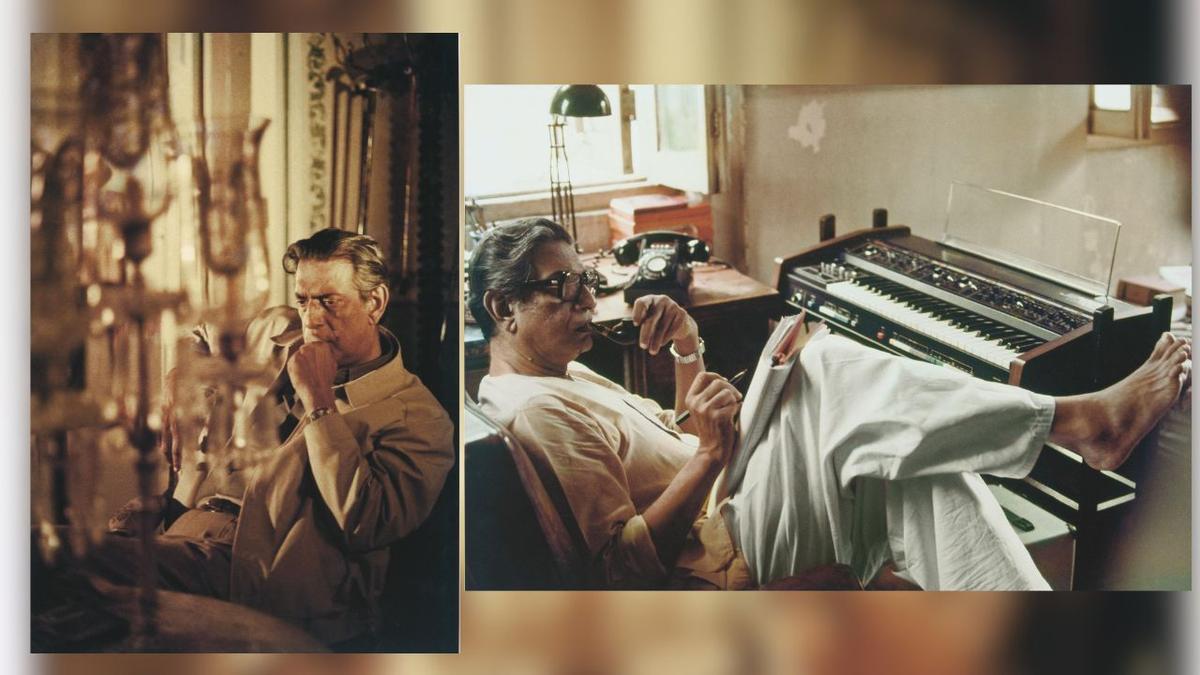
The photography of Nemai Ghosh, once an actor in Little Theatre, the theatre company of actor-director Utpal Dutt, and best known for his photo-biography of auteur Satyajit Ray, captured over 23 years, has busy, layered frames. Yet, as in the best of still photography, the focus is always on eloquent moments. Take one image from Faces and Facets: Satyajit Ray in Colour, an ongoing exhibition of 126 colour photos taken by him of Ray at work between 1970 and 1991, also the subject of DAG’s eponymous book released in 2020.
In one photo clicked on the sets of Ghare Baire (1984), Ray is directing lead actress Swatilekha Sengupta in front of a mirror. The actress seems to be taking in instructions as the director himself, looking down, fingers placed against the mirror, is focussed intensely on a gesture or detail that he wants in the frame. Ghosh’s lens is as focussed on Ray’s face and hands as Ray’s is on how to perfect that scene or frame.

Ghare Baire (1983)
| Photo Credit:
Courtesy DAG
Ghosh was Ray’s friend-cum-biographer, destined to a life in photography after a friend gave him a Canonet QL17 fixed-lens camera found left behind in a taxi. He started using it to chronicle Calcutta, among other things. A few years later, in 1968, Ray’s art director Bansi Chandragupta asked him to join the production unit as a still photographer.
The exhibition, part of DAG’s collection of Ghosh’s images of Ray, celebrates the photographer’s legacy — and, of course, his subject, the most well-known Indian filmmaker around the world both critically and historically, and recently a subject of an Instagram debate around the quality of Indian cinema audiences. But more importantly for the Artificial Intelligence (AI) age, the show offers the meditative and nuanced experience of looking at analogue photography. Analogue is a lifestyle movement today, and wellness aspiration. And photography as an art form is at the heart of it.
Influencer from a pre-influencer era
Ray doesn’t go out of fashion. Recently, an archival clip of Ray defending his anti-religious dogma stance in his 1960 film Devi became viral. In the interview, in his cut-glass English, Ray says: Indian audiences are “fairly backward” and “unsophisticated”. That quickly turned into a polarising debate about what is good cinema. Bollywood and populism supremacists even used director Aditya Dhar’s words to argue that Ray, who would have been 105 this year, was elitist and disconnected from mass audiences. Defending his superhit Dhurandhar (2025) against those who found it propagandist, Dhar had said, “The Indian audience is actually very very smart.”
But what’s striking about this show is the work behind the fixed-lens camera of Ghosh.

Ghare Baire (1983)
| Photo Credit:
Courtesy DAG
In 2026, when Ray is discussed, virality matters. Today, with AI efficiency, cinematic simulacrum is a matter of seconds. Beyond his historical and influential value — and his view of the world and audiences — Ghosh, whom Ray called his “Boswell with a camera”, recorded moments that make us see the slow burn process of the director’s craft, and what went into the dilated architecture of a Ray film.

Ray as Editor (1989). Ray (seated), his son Sandip standing behind him and his editor Dulal Dutta (far left).
| Photo Credit:
Courtesy DAG, Delhi
One image has Ray in the middle of editing with the Moviola machine (the first editing machine to be invented), with a tea cup in one hand, curiosity, a sense of urgency and fastidiousness informing his facial expressions, while his son Sandip bends over to look at the process, Ray’s editor Dulal Dutta by his side. In a few of the images, spread over DAG’s sprawling space, we see Ray in moments of deep reflection in a book-crammed den at his Bishop Lefroy Road home in Kolkata.

Ray Working at Home (1986)
| Photo Credit:
Courtesy DAG, Delhi
Process is at the soul of this body of Ghosh’s works. He was present on every set of Ray’s films beginning with Goopy Gyne Bagha Byne (1969) — unobtrusive but intentional, as chapters of the two books published by DAG on Ghosh’s work (Nemai Ghosh: Satyajit Ray & Beyond, 2013 and Faces and Facets: Ray in Colour, 2020) show.
It is universally accepted, at least outside of Silicon Valley deep tech labs, that mental, cerebral and creative processes are what distinguishes the work or artists or storytellers today. Ashish Anand, CEO and managing director, DAG (formerly Delhi Art Gallery) explains, “What distinguishes Ghosh’s work is that it is rooted in sustained observation. He did not photograph Satyajit Ray as a celebrity or public figure alone; he photographed a life, a practice and a creative temperament over more than two decades. There is patience, trust and an extraordinary depth of looking in these images.”
He adds, “Beyond the films themselves, Ray reminds us of the importance of depth in an age of speed, and of thoughtful engagement in an age increasingly defined by distraction.”
Archiving cultural memory
Much of the rich documentation of Ray’s legacy point to the fact that his world was built on process. From preparing to observing, chiselling and repeating. Whether designing a poster, composing a score or directing a film, he approached every task with the same seriousness of purpose. What distinguishes this repository of photographs is also its historical and representative significance. It preserves a visual record of a particular kind of Indian cinema beyond the scope of mass media and formulaic adaptation.

Deep in Thought (1983)
| Photo Credit:
Courtesy DAG, Delhi
DAG acquired the rights for Ghosh’s photographs of Ray, his actors and film sets and around 120,000 negatives from the photographer himself in 2006 as part of a broader effort to strengthen their engagement with photographic archives. Ghosh passed away in 2020 at the age of 85. By then, his work had already received considerable national and international recognition through exhibitions and screenings associated with platforms such as the Cannes Film Festival, Festival d’Automne à Paris, and Festival des 3 Continents in Nantes.

Ray Composing Music (1982)
| Photo Credit:
Courtesy DAG, Delhi
Anand says, “Through photography, we gain access to artistic processes, social histories and lived experiences that might otherwise be lost. For younger audiences in particular, archives such as Ghosh’s help develop visual literacy — the ability to read images critically and understand how they shape our understanding of history. In that sense, photography remains one of the most powerful educational tools available to us.”
Depth of field
Ray revealed a lot about his process in the Shyam Benegal documentary on him simply titled Satyajit Ray (1982). When Benegal asks his idol about form, Ray replies, “I would say that I am not interested in form to begin with. I’m interested in the subject and density. How telling can you make your images and how much can you pack into a film without using gimmicks, or whatever you call them — unconventional photography and editing.”

Sadgati (1981)
| Photo Credit:
Courtesy DAG, Delhi
Ray is the filmmaker he is because he is rooted in the local sinews of Bengal, in the best of 19th and early 20th century Bengali literature from which many of his films are adapted, and the deep attention to the filmmaking process, in order to achieve the density he talks about. Ghosh’s fixed-lens camera patiently and distinctly captures this quality in him. The same density came to be found in Ghosh’s work, too — not postcard-like or deliberately framed, but as real moments leading up to crafting cinema that the world doesn’t forget.
Faces and Facets: Satyajit Ray in Colour, at DAG, Delhi, till July 4.
The writer is a Mumbai-based journalist and health advocate, and behind the preventive health and longevity media IP @the_slow_fix.
#Satyajit #Ray #viral #rare #photographs #show #great