A little girl walks through the crowded streets of Tehran clutching money for a goldfish.
A boy runs across dusty villages searching for his friend’s notebook before school begins the next morning.
A brother and sister take turns wearing the same pair of shoes.
A child watches a revolution arrive at her doorstep.
These are among the most unforgettable images in Iranian cinema. Around these little details, some of Iran’s greatest filmmakers have built entire worlds. Revolutions rumble in the distance, poverty presses against the edges of the frame, governments rise and fall, ideologies harden, history changes course, and somewhere in the middle of it all, a child is watching.
The passing of Marjane Satrapi, writer of Persepolis, invites a return not only to her celebrated graphic memoir but also to one of the most distinctive traditions in modern storytelling where Iranian artistes have chosen to place children at the centre of their narratives. From Abbas Kiarostami’s wandering schoolboys in Where Is The Friend’s House? and Jafar Panahi’s determined young protagonist in The White Balloon to Majid Majidi’s children navigating hardship in Children of Heaven and Mohsen Makhmalbaf’s The President or A Moment of Innocence, the child recurs with remarkable persistence.

Marjane Satrapi
| Photo Credit:
Special Arrangement
This is emblematic of an aesthetic philosophy, a political strategy and, perhaps, a way of understanding history itself.
For, in Iranian cinema, history rarely announces itself through speeches, parliaments or battlefields. It enters like a season, unannounced, through a classroom, through a family argument, a closed door, or the puzzled gaze of a child who has not yet learned how adults disguise the truth.
Marjane Satrapi’s revolution
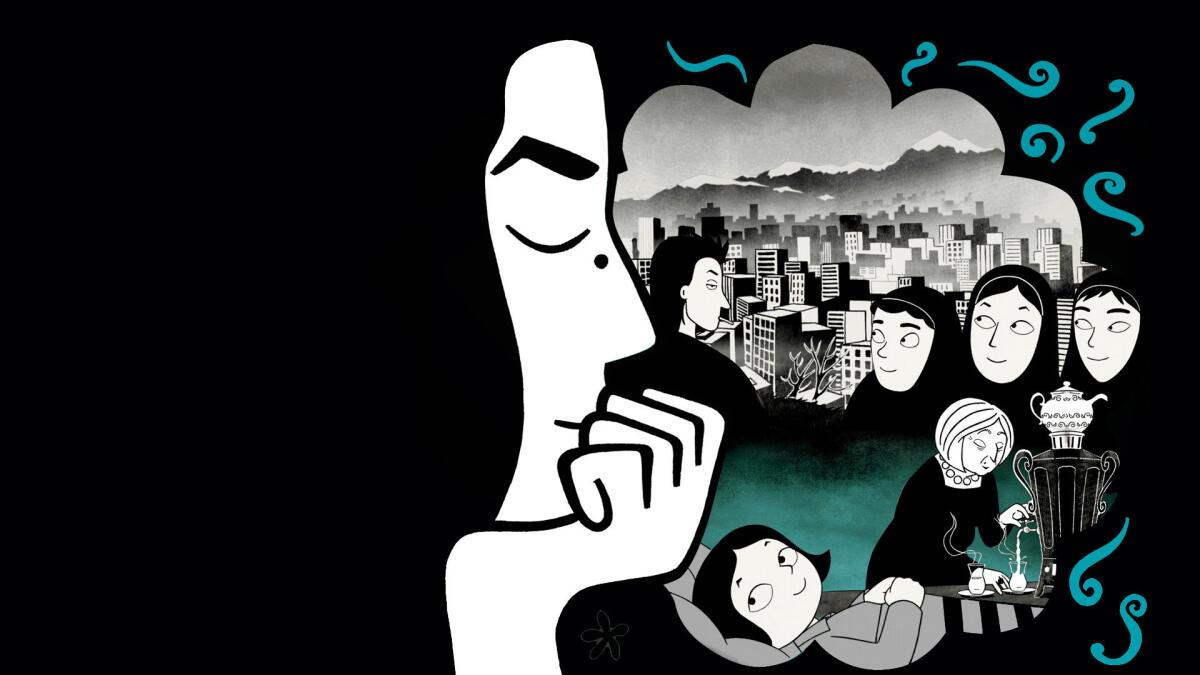
Published in 2000 and later adapted into an Academy Award-nominated animated film, Persepolis remains one of the most influential accounts of modern Iran. Even though its genius lies in its refusal to behave like political history. Satrapi does not begin with governments or ideologies. She begins with a little girl.

The Iranian Revolution arrives through the bewilderment of childhood. Veils suddenly appear in classrooms, friends disappear, family conversations grow hushed, bombs fall and posters appear on walls. Adults begin speaking in coded language and history enters the home before it enters the textbooks.
This is what links Persepolis so powerfully to the broader tradition of Iranian storytelling.

Children of Heaven (1997), Majid Majidi
| Photo Credit:
IMDB
Like the children of Kiarostami, Panahi, Makhmalbaf and Majidi, Marji is both participant and observer. She stands close enough to history to feel its consequences and distant enough to see its absurdities. Her innocence allows Satrapi to expose contradictions that adults have learned to rationalise.
The achievement of Persepolis is that it transforms one of the 20th century’s most consequential political upheavals into something profoundly intimate. The revolution is not experienced as a national event. Instead, it is experienced as childhood being interrupted.
In Satrapi’s hands, the child is history’s conscience.

Marji, short for Marjane, the curious and dreamy protagonist in Satrapi’s Persepolis
| Photo Credit:
Special Arrangement
Perhaps that is why Persepolis continues to resonate far beyond Iran. Readers may know little about the complexities of the revolution, but they recognise what it means to watch the adult world suddenly become frightening and incomprehensible. Every child, in some sense, experiences history this way and Satrapi gave that experience a voice.
The innocence of the outsider
Professor Sanjoy Mukhopadhyay, former Head, Department of Film Studies, Jadavpur University, believes the child occupies a special place in cinema because of a paradox. The child is deeply present in the world yet remains curiously detached from it.
“A child is an innocent observer,” he says. “Someone who remains outside the periphery of life.”
He traces this tradition back to Satyajit Ray’s Pather Panchali. Through Apu’s eyes, death, poverty, disappointment and wonder unfold with equal intensity. Yet, because the child does not fully grasp the magnitude of what he witnesses, the audience experiences events with a peculiar emotional distance. Life reveals itself before it is interpreted.

Apu in Satyajit Ray’s Pather Panchali (1955)
| Photo Credit:
Special Arrangement
“However, children in Iranian cinema do not embody this emotional distance but political action. Through the visual trope of a child, Jafar Panahi or Abbas Kiarostami is able to say many things which he may not have been able to say through an adult narrator,” says Sanjoy. “

Ahmad, protagonist of Abbas Kiarostami’s Where Is the Friend’s House? (1987)
| Photo Credit:
Special Arrangement
Children observe before they judge. Their gaze is uncluttered by ideology, prejudice and certainty. What emerges is a cinema of extraordinary attentiveness, where seemingly minor incidents acquire the force of revelation.
Consider Jafar Panahi’s The White Balloon. On the surface, almost nothing happens. A little girl wants a goldfish for Nowruz. Yet as she moves through Tehran’s streets, the city gradually unfolds around her. Soldiers, shopkeepers, migrants, snake charmers, workers and strangers drift in and out of the frame. By the end, the film has quietly revealed an entire society. The goldfish was never the destination, the journey was.

Jafar Panahi’s The White Balloon (1995)
| Photo Credit:
IMDB
The same principle appears in Ritwik Ghatak’s Bari Theke Paliye, where the young Kanchan becomes a vehicle through which viewers encounter the world afresh. The child allows audiences to experience what Sanjoy calls a “virgin experience”, one unclouded by judgement or ideology.

A still from Ritwik Ghatak’s Bari Theke Paliye (Runaway) (1958)
| Photo Credit:
Special Arrangement
However, in Iran, the child is not a vehicle of keeping a distance from the events of the film. The child is a medium of political action. What was aesthetic in Ray often becomes political in Panahi and Kiarostami.
The politics of innocence
Sanjoy goes on to explain that, for decades, Iranian filmmakers have worked under varying degrees of censorship and ideological control. In such an environment, direct political speech can become difficult. Every word risks interpretation. Every statement invites suspicion. The child offered a way around these barriers.
“What happens is that if the child is taken as the dramatic persona, it becomes easier to negotiate with the establishment. You can always say that this is not an adult interpretation of life. This is simply what a child saw,” he explains.
The distinction is subtle but powerful because an adult narrator arrives carrying opinions. A child arrives carrying questions. An adult may appear political but a child appears dreamy and curious. A filmmaker can place difficult realities before the audience while maintaining the appearance of innocence.
“It becomes a game of hide-and-seek. Through the visual trope of a child, filmmakers such as Jafar Panahi or Abbas Kiarostami are able to say many things they may not have been able to say through an adult narrator,” Sanjay notes.

Where Is the Friend’s House? (1987)
| Photo Credit:
Special Arrangement
This explains why so many Iranian masterpieces begin with premises that seem deceptively simple. In Abbas Kiarostami’s Where Is the Friend’s House?, a boy merely wants to return a classmate’s notebook. However, beneath the journey lies a meditation on authority, obligation and moral responsibility.
Memory, revolution and the lost child
No filmmaker explored the relationship between innocence and political memory more movingly than Mohsen Makhmalbaf. In A Moment of Innocence, Makhmalbaf revisits an incident from his youth when, as a teenage revolutionary, he stabbed a policeman. Instead of reconstructing the event as historical fact, he stages an encounter between memory and imagination. Young actors are asked to become the people they once were. The result is, an attempt to recover the innocence that history destroyed.

Mohsen Makhmalbaf’s A Moment of Innocence (1996)
| Photo Credit:
Makhmalbaf Film House
Years later, in The President, Makhmalbaf returned once more to the figure of the child. As a fallen dictator flees revolution with his young grandson, the child becomes the story’s moral centre. Moving through a landscape scarred by power and violence, the grandson sees what adults often cannot. He sees human beings before he sees ideology. He sees suffering before he sees politics. Like so many children in Iranian cinema, he becomes a witness wandering through history’s ruins.

Mohsen Makhmalbaf’s The President (2014)
| Photo Credit:
Special Arrangement
Like the children of Kiarostami, Panahi, Majidi and Makhmalbaf, Marjane’s Marji stood at the edge of history and watched. In doing so, Marjane Satrapi joined one of Iran’s most remarkable artistic traditions: trusting a child to tell the truth when adults no longer can.
#Marjane #Satrapi #Persepolis #Panahi #Iranian #cinema #sees #history #childs #eyes