Conservation scientist Krithi Karanth has an audacious goal: to strengthen the conservation programmes of the Centre for Wildlife Studies (CWS), the organisation she spearheads, across a 100 wildlife reserves of the Eastern and Western Ghats. “We have designed a range of programmes that we know are already working at different scales and depths in the country, but we can go much deeper,” says Krithi, who was named the 2026 Rolex National Geographic Explorer of the Year, an award she received at the Society’s annual Explorers Festival earlier this month.
Also read: Krithi Karanth’s rules of co-existence
Krithi feels that her professional collaboration with National Geographic has come full circle with this honour. “From being their 10,000th grantee to Wayfinder in 2012, and over the years, being awarded multiple grants, I have a 15-year relationship with National Geographic,” she says, recalling that when she returned to India in 2010, after her postdoctoral research at Columbia University, New York, she received her first grant from the Society.
“Nat Geo invests deeply with young people, who they think have potential, and supports them long-term. So, I think, for them also it is reassuring and exciting that someone they’ve known for 15 years is doing long-term impactful work,” says the Bengaluru-based Krithi. “The fact that an institution like Nat Geo, which believes in you when you are young, nurtures you and supports you through all your career ups and downs, has chosen me to be the first South Asian to receive this award is something I am very honoured by.”
Krithi’s passion for the natural world began very early. Growing up as the daughter of one of India’s leading tiger experts, Ullas Karanth, meant that she spent much of her childhood in forests. “My mum was also a busy professional, so when she had to travel, she would leave me with my dad. And he was usually in the jungle, so I would go along with him and watch animals,” she says about her childhood experiences, which she still cherishes and describes as “absolutely amazing.” Looking back, she feels incredibly privileged to have grown up amidst wildlife. “I was really lucky,” says Krithi, who went on to complete a Master’s in Environmental Science at Yale University in Connecticut and a PhD at Duke University in North Carolina, and is today the CEO of CWS, the organisation founded by her father in 1984.

The increasing number of elephants in the Western Ghats is seen as a major reason for frequent conflict in several villages along its range
| Photo Credit:
H VIBHU
Among the key areas of research carried out by CWS is human-wildlife conflict, which seems almost inevitable in India, given “the high densities of people living next to really large megafauna. I think it is time that people realised that we are working at extremes, and there is an immense challenge ahead,” she says.
Also read:Krithi K. Karanth named to the 2024 class of The Explorers Club 50
But she remains optimistic, especially because of what she calls India’s “cultural tolerance” for wildlife, which she says, “sets it apart from most of the world.” Yet another reason for Krithi’s optimism is the work many organisations, including CWS, are doing on the ground to help mitigate conflict. “I always think about what if we, as one organisation, didn’t do the work we did. I just feel that if we weren’t there, a lot more people would be frustrated and not be helped.”
CWS, she points out, currently runs six conservation programmes; one of them is Wild Seve, which started 11 years ago, and provides timely assistance to people affected by human-wildlife conflict. “It was based on years of field research on understanding human-wildlife interactions across India. Prior to that, I had published a lot of papers showing that India is a high wildlife-conflict country,” she says, adding that while there are no guaranteed wins, it is important to spend time building trust and forging partnerships with the people living in close proximity to nature, who are most affected by animals like leopards, tigers, elephants and bears. “We can’t say that wildlife comes first. We also have to be in places long-term and figure out how to make people’s lives better.”
Wild Shaale, CWS’s flagship nature education programme for school children living around wildlife reserves in India, launched in 2018, also stems from this ethos. “We were in all these villages helping adults in the community cope with conflict-related losses, and would come across children who saw elephants and leopards on a daily basis, but didn’t necessarily view them in a positive light.”

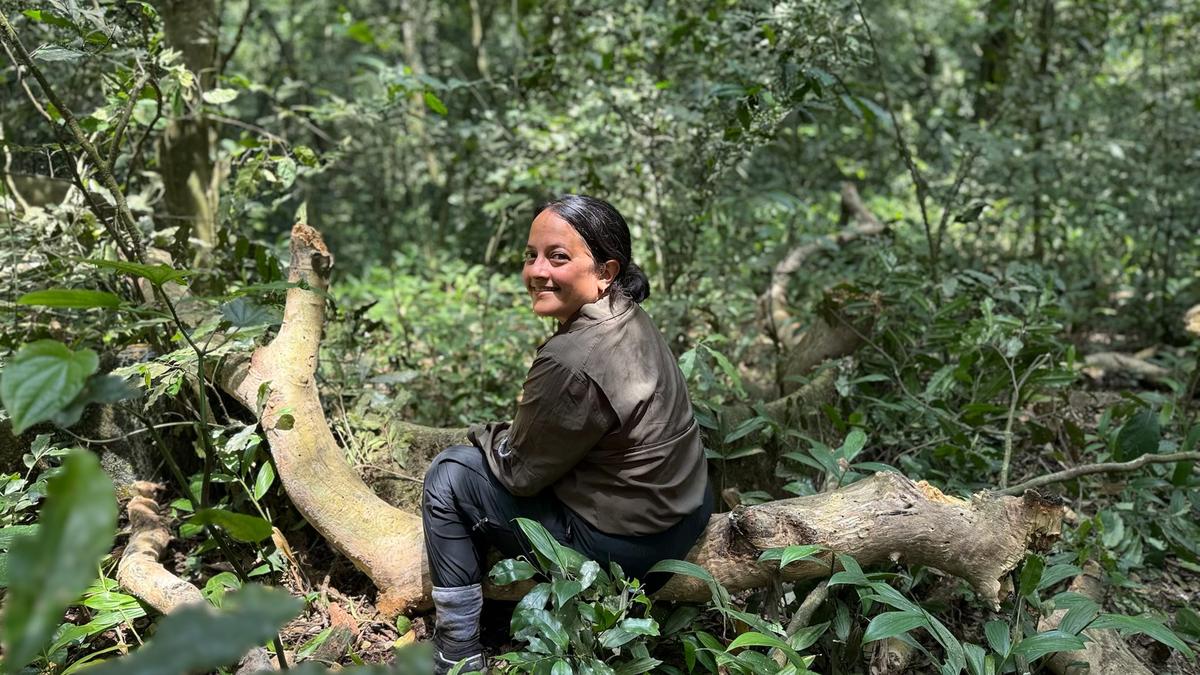
Krithi Karanth says that she spent much of her childhood in forests with her father
| Photo Credit:
Special Arrangement
The programme, which was designed with well-known conservation photographer and environmental scientist Gabby Salazar, seeks to change this narrative, enabling them to “celebrate the diversity of wildlife in India, understand the interconnectedness of species, get them to understand why conflict happens and how, if you are confronted by a sloth bear or elephant, how do you keep yourself safe.”
While environmental literacy is a key goal of this programme, Wild Shale is also attempting to nurture empathy among children in the places where it works. “Indian kids are highly empathetic to begin with, but we are building on their connection to their local wildlife and environment through a program like this.” Moreover, Wild Shaale is being tailored depending on the prevailing circumstances on the ground. “Also, since we are working in several States, including Maharashtra, Goa, Karnataka, Tamil Nadu and Kerala, we have customised the programme culturally, ecologically and rooted in multiple languages.”

Wild Shaale, CWS’s flagship nature education programme, seeks to nurture empathy in school children living around wildlife reserves in India
| Photo Credit:
Special Arrangement
The success of the organisation, acknowledges Krithi, is in large part due to her “hundred and fifty amazing colleagues at CWS.” According to her, most of the team hail from the areas where they work, leading to a deep sense of pride and ownership in their work. “It is the only way to do conservation. You cannot import and export people in or out,” she says. After all, pride in one’s State is as much a part of an Indian’s identity as pride in the nation, believes Krithi. “Somehow we navigate these dual identities, but harnessing that pride is very important to do meaningful work.”
Published – July 01, 2026 07:14 pm IST
#Krithi #Karanth #named #Rolex #National #Geographic #Explorer #Year