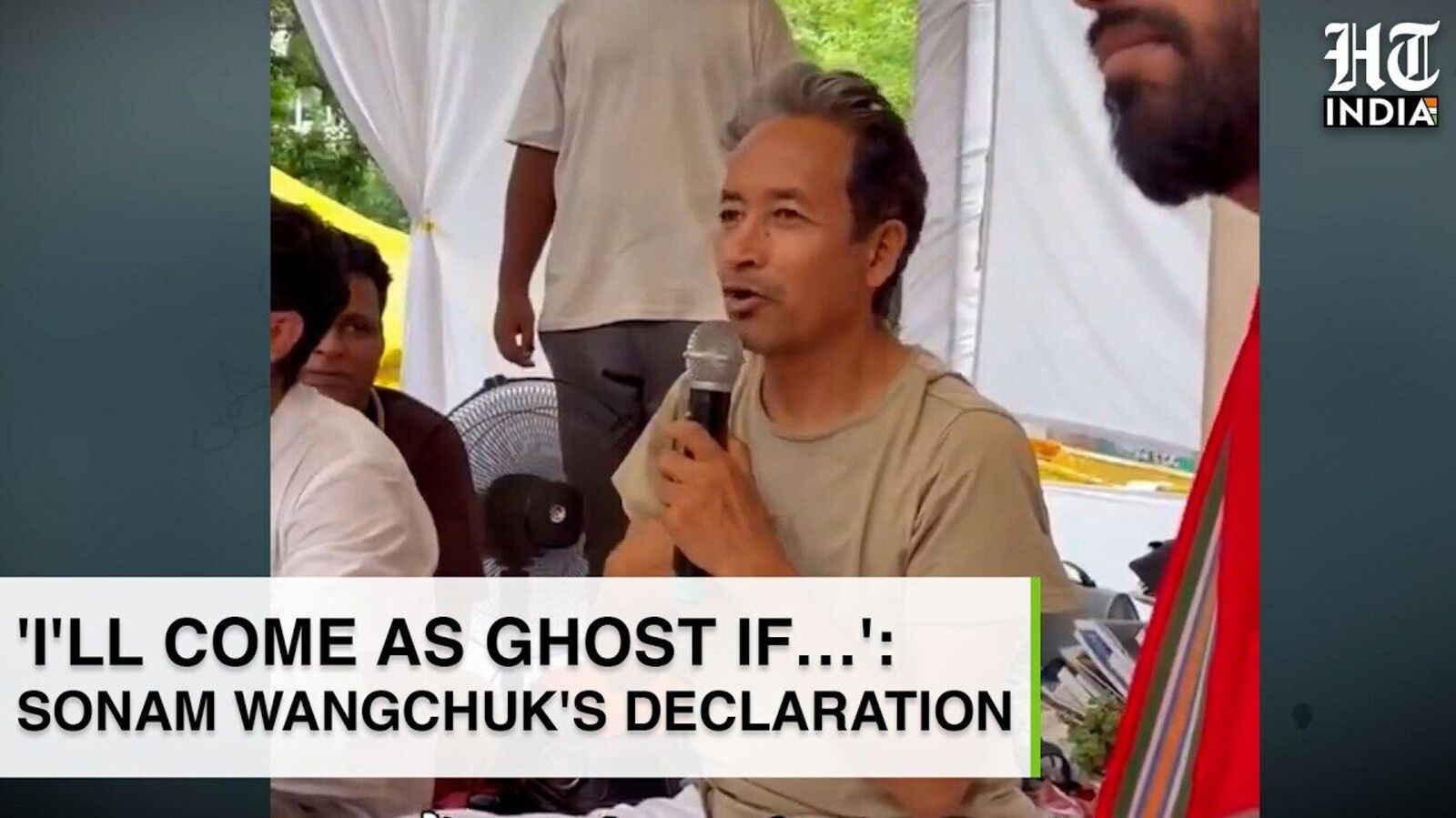
Renowned activist Sonam Wangchuk has been on an indefinite fast for 20 days in heart of the national capital, demanding the resignation of Union Education Minister Dharmendra Pradhan over alleged irregularities in the NEET examination.
The Cockroach Janata Party (CJP) has been holding a protest for over 25 days at Jantar Mantar in central Delhi. Wangchuk, 59, joined the agitation on 28 June and has been on an indefinite fast since then.
Wanghuk is globally renowned as a passionate advocate for the environment and his home region and has also been involved in demonstrations for greater constitutional safeguards for Ladakh. He has been on a hunger strike three times before the current protest that began twenty days ago at the iconic Jantar Mantar.
India has a history of hunger strikes before and after Independence. Mahatma Gandhi was on a hunger strike for 21 days in 1933. Bhagat Singh for 116 days in 1929. Former Bengal chief minister Mamata Banerjee sat on a 25-day-long hunger strike in 2006, while activist Anna Hazare’s 13-day hunger strike in 2011 had a wide-ranging impact on India’s political landscape.
Here is a look at India’s longest-known hunger strikes after Independence:
Irom Sharmila – 16 years
Irom Sharmila fasted for 16 years demanding the repeal of the Armed Forces Special Powers Act (AFSPA) in Manipur. The fast is known as the world’s longest hunger strike.
Sharmila, known as ‘Iron Lady of Manipur,’ began her fast on 5 November 2000, in which 10 civilians were allegedly shot dead by security personnel near Imphal. The fast lasted till 9 August, 2016.
Sharmila ended the fast in 2016 to enter electoral politics.
Swami Nigamananda – 115 days
Swami Nigamananda also known as Nigamanand Saraswati was a Hindu monk who breathed his last after undertaking a 115-day hunger strike. Swami Nigamananda was protesting against illegal sand mining in the Ganga River bed in Haridwar, Uttarakhand in 2011. He died on June 13, 2011, at a Dehradun hospital. The death drew national attention and prompted action against illegal mining in parts of the region. Activists, however, said that the broader concerns are still unresolved.
Darshan Singh Pheruman – 74 days
Sikh activist Darshan Singh Pheruman observed a fast-unto-death protest on August 15, 1969. Pheruman was demanding inclusion of Chandigarh and Punjabi-speaking areas into Punjab
Punjab was created in 1966 on linguistic lines, however, not all Punjabi-speaking areas had been shifted under the state. Darshan Singh Pheruman died in 1969 after refusing to take food in any form.
He died after a 74-day fast, but his principal demands, including the transfer of Chandigarh to Punjab, were never fully met.
Potti Sriramulu – 58 days
Sriramulu was a freedom fighter who played a pivotal role in the creation of Andhra Pradesh State. Sriramulu was a part of many independence movements, including the Salt Satyagraha and Quit India movement, and was imprisoned multiple times.
In 1952, he went on a 58-day hunger strike, demanding a separate state for Telugu-speaking people from the Madras Presidency. Sriramulu death during the protest sparked widespread riots and public outcry, forcing PM Jawaharlal Nehru to announce the creation of Andhra Pradesh in 1953.
Mamata Banerjee – 26 days
Mamata Banerjee went on a hunger strike against the acquisition of farmland in Singur for the Tata Nano project in 2006 . The protest was aimed at the Communist Party of India (Marxist)-led West Bengal government’s forceful acquisition of 997 acres of fertile, multi-crop farmland for the Tata Nano car factory in Singur.
The protest became a turning point in West Bengal politics and helped build momentum against the Left Front government. Mamata Banerjee fasted for 26 days.
Banerjee’s health deteriorated drastically during the fast, prompting personal interventions from then-President APJ Abdul Kalam and Prime Minister Manmohan Singh. She called off the strike at midnight on 29 December 2006, after receiving a written appeal from the Prime Minister promising to resolve the land dispute.
Mamata Banerjee became chief minister of Bengal in 2011 and continued for three straight terms until 2026.
Anna Hazare – 13 days
Social activist Anna Hazare began his first indefinite hunger strike at Jantar Mantar on April 5, 2011, demanding the enactment of a stronger anti-corruption law. The fast sparked a nationwide movement against corruption, drawing support from students, professionals, civil society groups and political activists across the country.
Hazare announced a second indefinite fast in August 2011 after disagreement with the government’s proposed legislation. He was briefly arrested before the protest began, triggering widespread public outrage. The fast was then shifted to Ramlila Maidan, where thousands of supporters gathered daily, making it one of the largest mass protests in India since Independence.
The protest led by Hazare ultimately led to the passage of the Lokpal and Lokayuktas Act, 2013, marking significant progress in India’s fight against corruption.
The movement was eventually called India Against Corruption (IAC) and paved its way for the formation of Aam Aadmi Party led by Arvind Kejriwal.
Key Takeaways
- Hunger strikes have historically been a powerful tool for protest in India, catalyzing significant political changes.
- Prominent figures like Sonam Wangchuk and Anna Hazare have revived this method, drawing attention to pressing social issues.
- Understanding these protests can illuminate the broader social movements within India’s historical and contemporary context.
#Sonam #Wangchuks #hunger #strike #enters #Day #Indias #longest #fasts