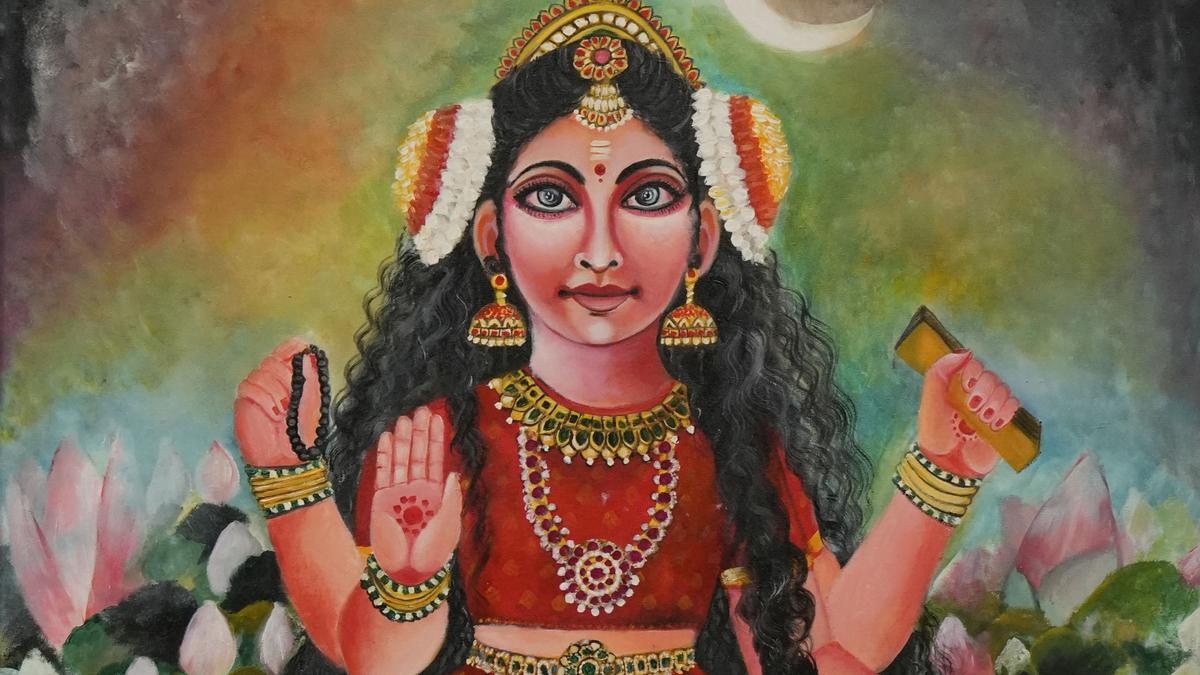

Beena Unnikrishnan’s desire to paint Ma Tripura Sundari led her to explore more about the 64 Yoginis.
| Photo Credit: Special Arrangement
Among the Hindu pantheon of gods and goddesses, the idea of the Chausath (64) Yoginis occupies a distinct and somewhat enigmatic place. The Yoginis are a group of 64 female divinities, associated primarily with Shakta and Tantric practices between the 9th and 12th centuries. Unlike mainstream temple deities placed within enclosed sanctums, Yogini temples were often circular and open to the sky, as seen in historic sites such as Hirapur in Odisha and Bhedaghat in Madhya Pradesh. Scholars interpret this architectural form — symbolising cosmic wholeness — as a space that easily allowed conducting moonlight rituals.
It is this legacy that artist Beena Unnikrishnan engages with in her project ‘Ekaa: The One’. Over a decade, she has created a complete painted series envisioning all 64 Yoginis through her contemporary interpretation. The works are not copies of temple sculptures, nor are they academic reconstructions, but artistic reflections inspired by the idea of feminine energy as understood within Hindu philosophy.
“It all started with the desire to paint Ma Tripura Sundari, and that led me to know about the 64 Yoginis or her 64 expressions. As I started painting these feminine powers, their different aspects began to unravel,” says Beena, who is travelling with the show and has so far exhibited her creations in eight cities. Her current stopover is Delhi, where her works are on display at the Visual Art Gallery, India Habitat Centre. The project is on an 81-day road journey across India, and moves to Gwalior after Delhi. Each stopover is a three-day exhibition.
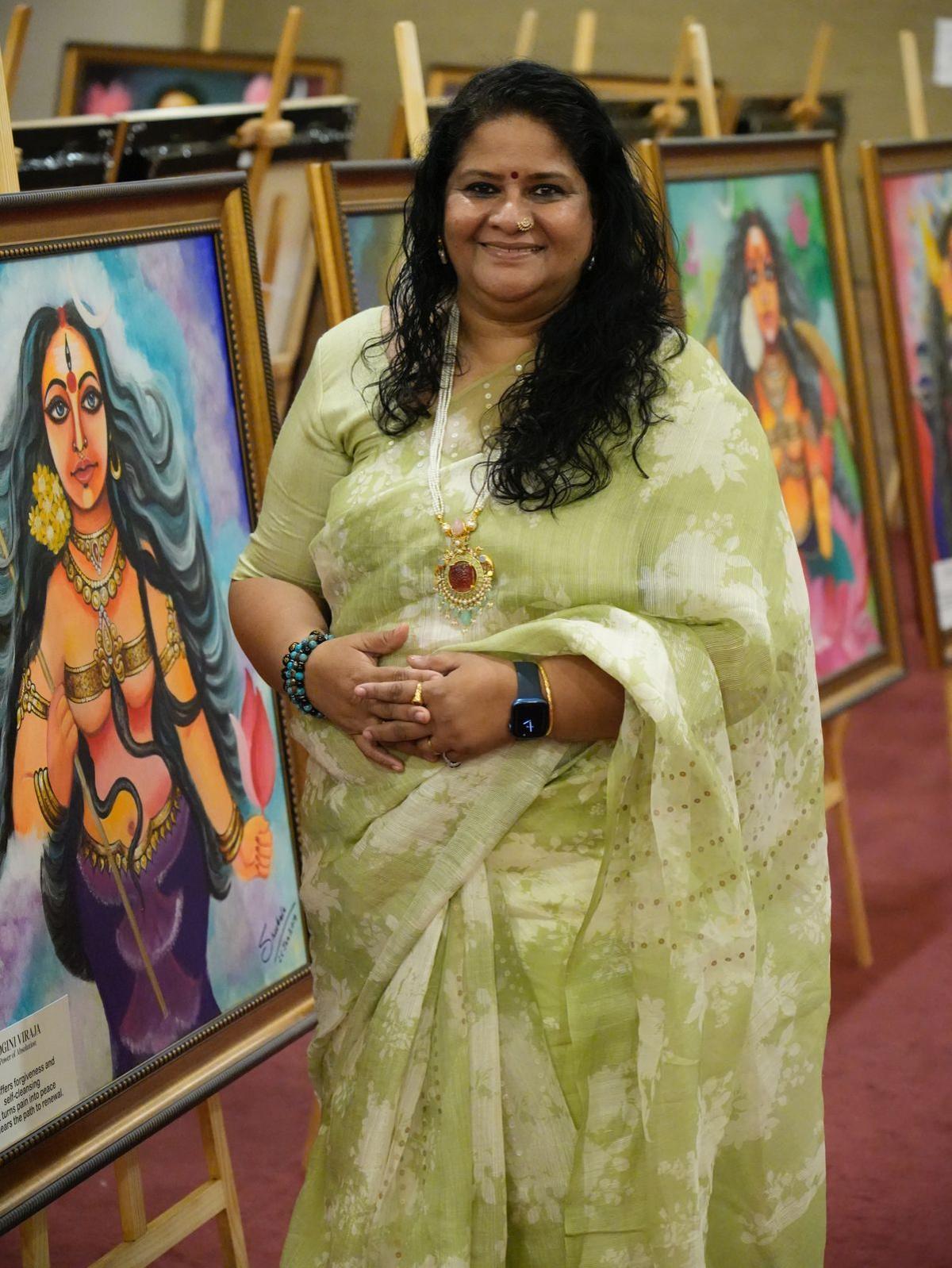
Beena Unnikrishnan’s paintings of the 64 Yoginis are inspired by the idea of feminine energy within Hindu philosophy.
| Photo Credit:
Special Arrangement
The Yoginis are manifestations of Shakti, the primordial feminine power that sits at the core of creation in the Hindu philosophy. They represent dynamic energies of Nature, consciousness, protection, transformation, and wisdom. Some are benevolent, others fierce and together they reflect the many dimensions of the feminine-divine. Over time, Yogini worship has declined due to various social factors, but the concept of the 64 Yoginis remains a significant part of the sacred feminine traditions in India.
We find references to them in texts such as Durga Aarti. Bahurup, Tara, Narmada, Yamuna, Shanti, Varuni, Kshemankari, Aindri, Varahi, Ranveera, Vanarmukhi, Vaishnavi, Kalaratri, Vaidyarupa are the names of some of the Yoginis.
Beena, a self-taught artist and founder of the Kankali Trust for Arts and Cultural Economic Development, describes the project as a creative and personal journey.
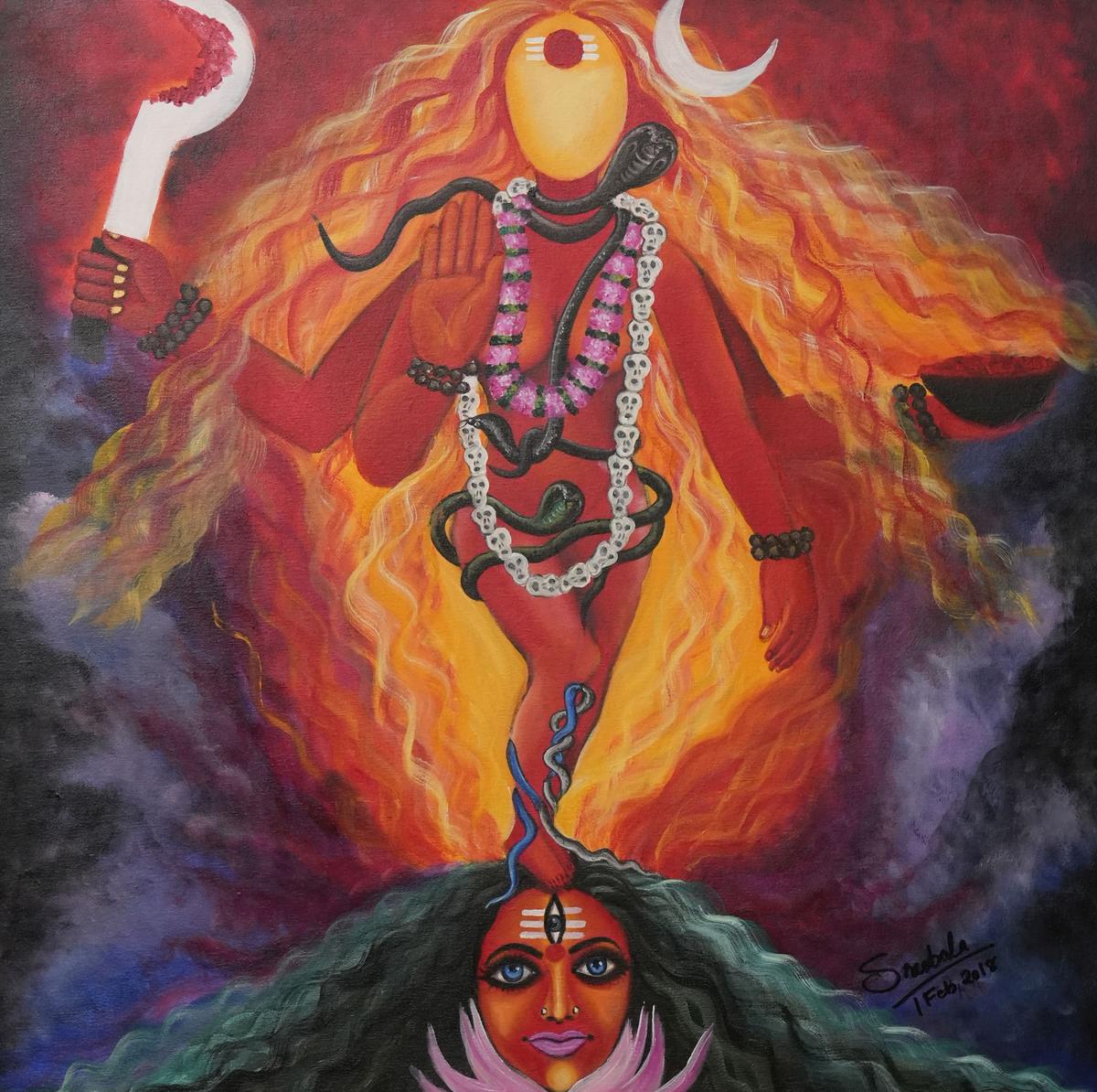
One of the Yogini paintings currently on display at the the Visual Art Gallery, India Habitat Centre, New Delhi.
| Photo Credit:
Special Arrangement
The exhibition brings together painting, narrative context and interactive elements to introduce the viewers to the philosophical idea of Shakti. In order to enable the common man to relate to it, the artist has refrained from giving detailed captions. She has simply called them ‘Motherhood’, ‘Resilience’ and so on. “I have not learnt art formally, nor am I a spiritual practitioner, and that has given me freedom to experiment with form, colours and concept,” she says.
By rendering the Yoginis a contemporary visual vocabulary, ‘Ekaa: The One’ attempts to reconnect viewers with a lesser-known aspect of India’s spiritual heritage.
(The exhibition is on view at India Habitat Centre, Lodhi Road, New Delhi from February 21-24. Next stopover at Gwalior on February 27 and 28.)
Published – February 21, 2026 04:37 pm IST
#travelling #exhibition #presents #Yoginis #modern #art