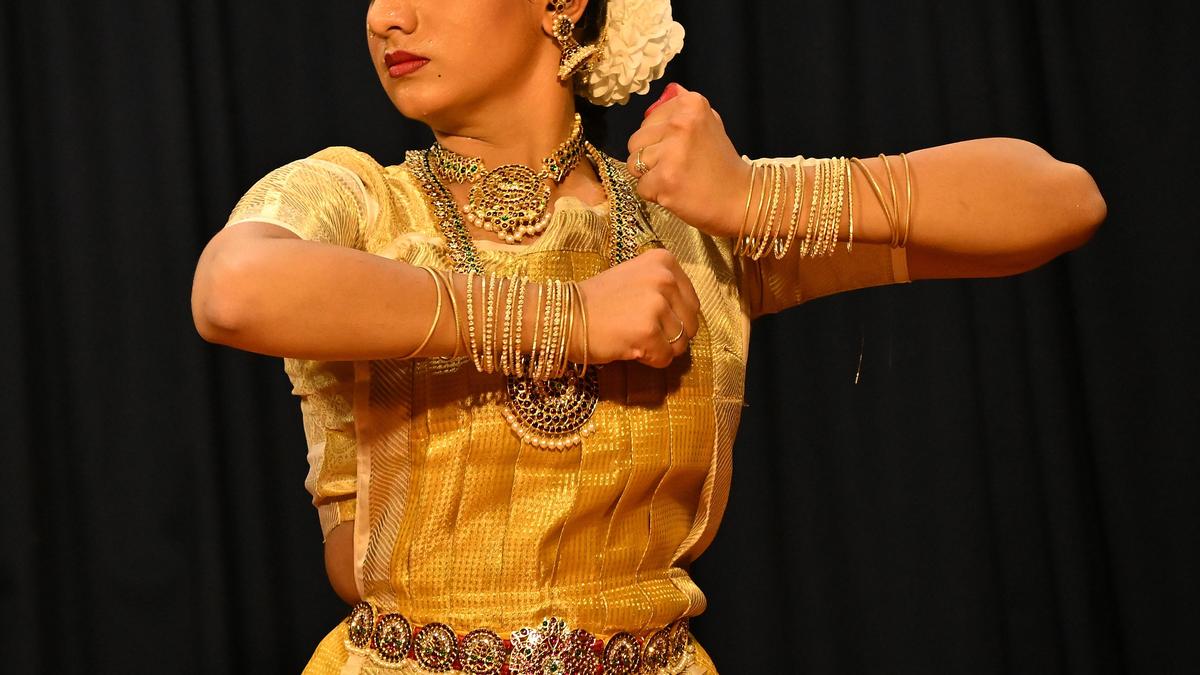

Nivrritii Mahesh.
| Photo Credit: B. Velankanni Raj
The stage was set with a camera mounted on a tripod aimed at the nattuvangam artiste, its live-feed visible on a small monitor positioned at the stage level, just a few feet away from the performance area. Seventeen-year-old Bharatanatyam dancer Nivrritii Mahesh, exuding confidence and poise, commenced her recital with a Gambhira Natai Ganesha invocation. She followed it up with a rigorous Simhendramadhyamam varnam, a Chandrakauns keerthanam, Shama padam, and a lively Sindhubhairavi thillana with steady grace. Her recital was part of Naada Sparsh programme, presented by SciArtsRUs under their initiative — Artabilities 4 All. The venue was Narada Gana Sabha’s mini hall.
Watching the seamless flow of her dance, it would be difficult to imagine that Nivrritii was born with hearing impairment. She dances using bilateral cochlear implants — electronic devices in both ears that help her perceive sound.
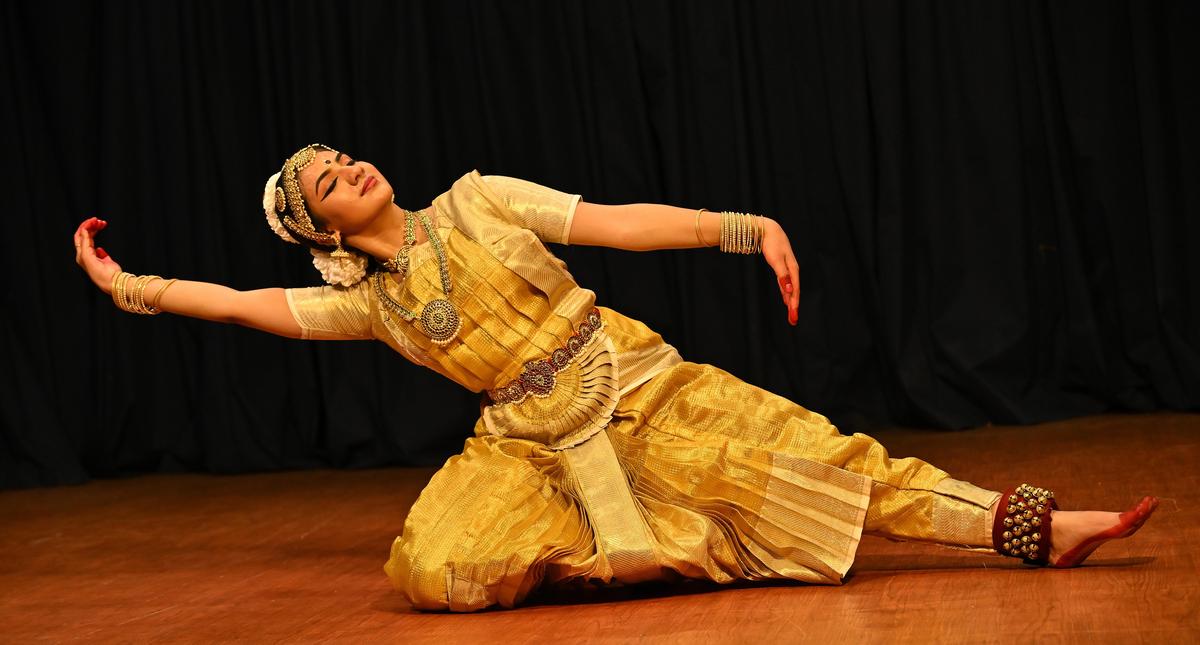
Confidence met grace on the stage.
| Photo Credit:
B. Velankanni Raj
Throughout her recital, Nivrritii worked closely with her mother and guru, Aishwarya Chakravarthy, who provided her withrhythmic cues and also handled the nattuvangam. Her nattuvangam was captured on camera and streamed on to the stage monitor for Nivritti to follow, while sound engineer Nambukumar Krishnan fine-tuned the audio balance. The accompanists — vocalist Srikanth Gopalakrishnan, violinist R. Kalaiarasan and mridangist N.K. Kesavan supported the young dancer with sensitivity.
Nivrritii’s story of resilience and passion reflects the determination of both the mother and the daughter. Their collaborative spirit transforms challenges into a celebration of music and movement. After cochlear implant surgery in the U.S. in 2012, Nivrritii was able to hear and speak for the first time at age five. Recalling her initiation into Bharatanatyam, she says, “Soon after the surgery, I attended my mother’s dance classes, and later, enjoyed listening to stories of Krishna and Ganesha. My mother asked me to write the stories and lyrics of the songs several times. To deepen my understanding, she would show me videos of these stories on YouTube.”
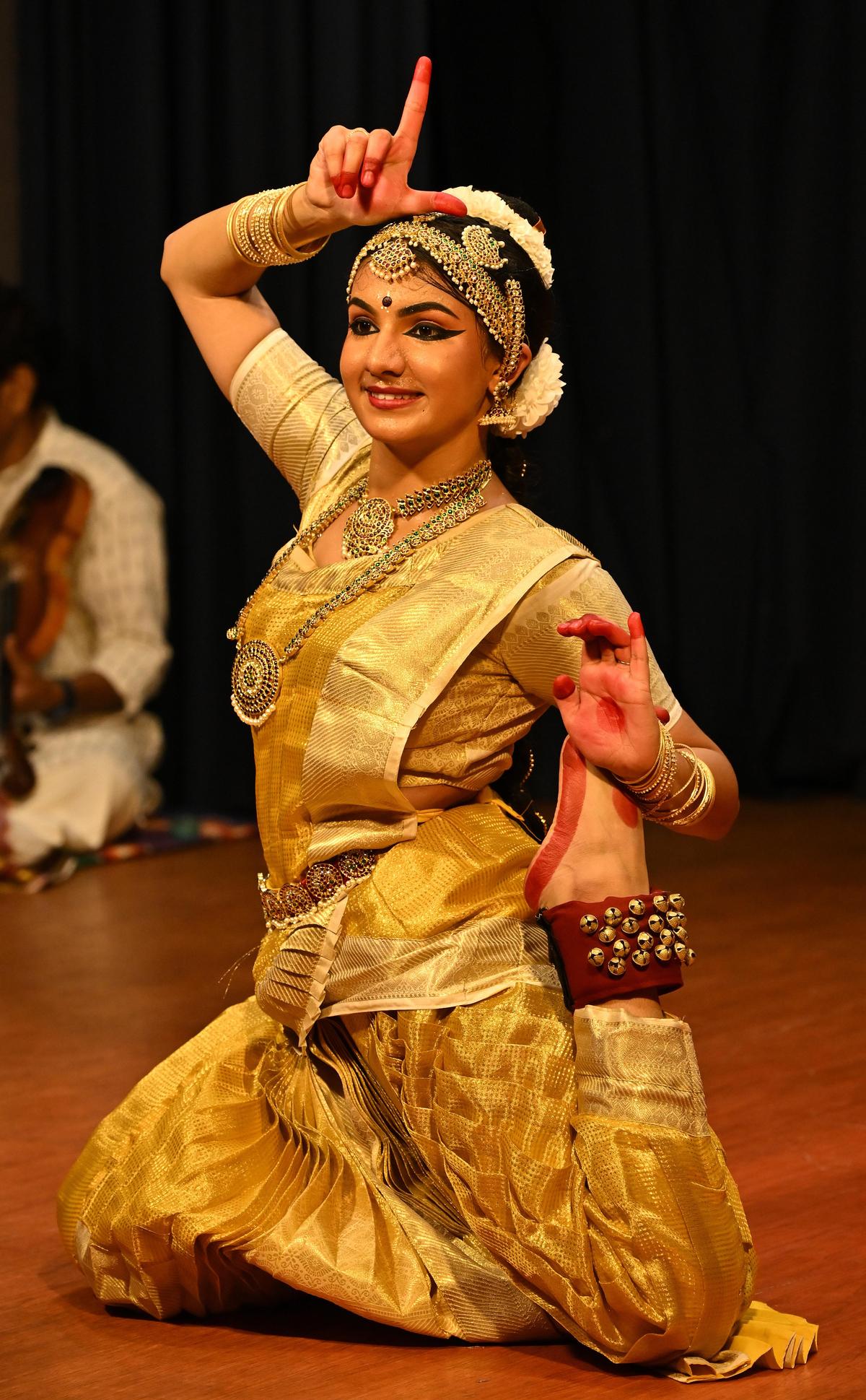
Nivrritii credits Bharatantayam for instilling positivity and purpose.
| Photo Credit:
B. Velankanni Raj
After a few years, she became part of the group dance presentations choreographed by her mother. Over time, challenges arose. The cochlear implants “helped me hear speech, but not all the tones and layers of live rhythmic and melodic instruments. The mridangam’s beats were sometimes too strong, and other external sounds interfered. This made it almost impossible to follow the orchestra’s rhythm and melody. The variety of sounds was overwhelming,” says Nivrritii.
It was during this time that Aishwarya turned to technological support to help her daughter overcome these challenges. She, along with sound engineer Nick Powell, built a dual-channel audio system connected to her cochlear implant receiver. Nivrritii explains, ”One audio channel transmitted a custom-balanced orchestra mix, where critical rhythmic cues such as the nattuvangam and vocal counts were amplified, while less-essential instruments were softened. A second private channel allowed her mother to provide live counts and guidance directly to me when needed.” Additional visual support, using a confidence monitor, helped Nivrritii follow her mother’s rhythmic cues and nattuvangam, in case she lost the beat.
When her mother suggested that she opt for a shared arangetram last June, Nivrritii had other plans. “It’s a once-in-a-lifetime opportunity, and I was determined to present a solo arangetram. Though not easy, I was keen to preserve the traditional stage arrangement, with the instrumentalists and vocalists seated to the side,” she says. Senior artistes Madurai R. Muralidharan and Renjith Babu and Vijna Vasudevan helped Nivrritii with her arangetram repertoire. “Muralidharan sir choreographed most of the pieces to suit my calibre. Renjith anna and Vigna akka mentored me on easy techniques to understand the compositions and strengthen choreography retention.”
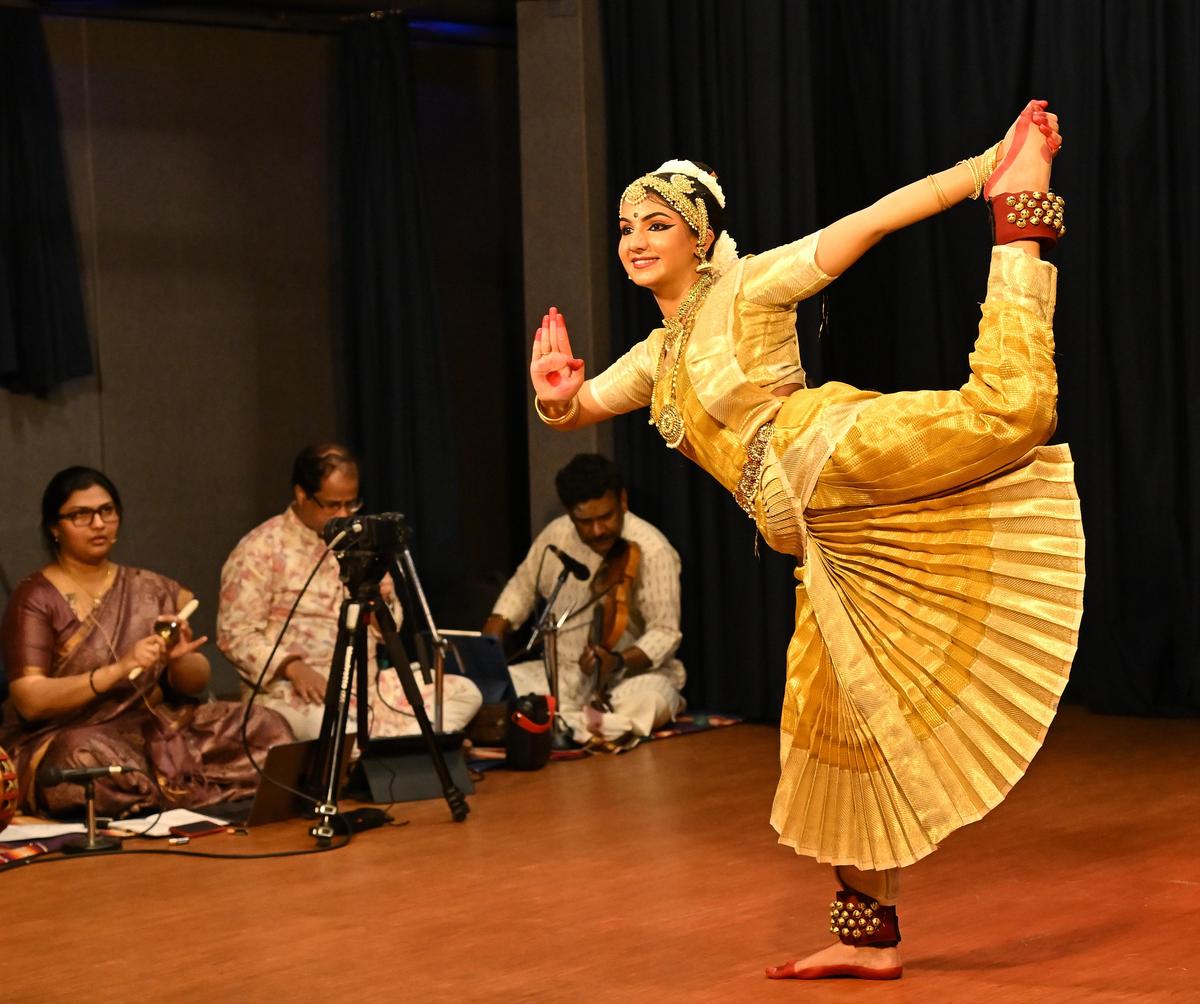
Her mother and Bharatanatyam guru, Aishwarya Chakravarthy, provides her with rhythmic cues and handles the nattuvangam.
| Photo Credit:
B. Velankanni Raj
Nivrritii credits Bharatantayam for instilling positivity and purpose. “The stories my mother narrated from the Puranas to deepen my understanding of bhakti. This divine essence has been my source of strength, enabling me to embrace challenges,” says Nivriti, a staunch believer in the Bhagavad Gita.
Nivrritii plans to further use technology by exploring tools that can support her practice. “Through SciArtsRUs, a non-profit organisation, I am planning to work with haptic technology (touch-based vibration feedback) to help me internalise rhythm and movement more deeply, and to share Bharatanatyam with people who experience sound differently,” shares Nivrritii.
Published – March 21, 2026 06:04 pm IST
#Cochlear #implant #enables #Nivrritii #Mahesh #perform #Bharatanatyam