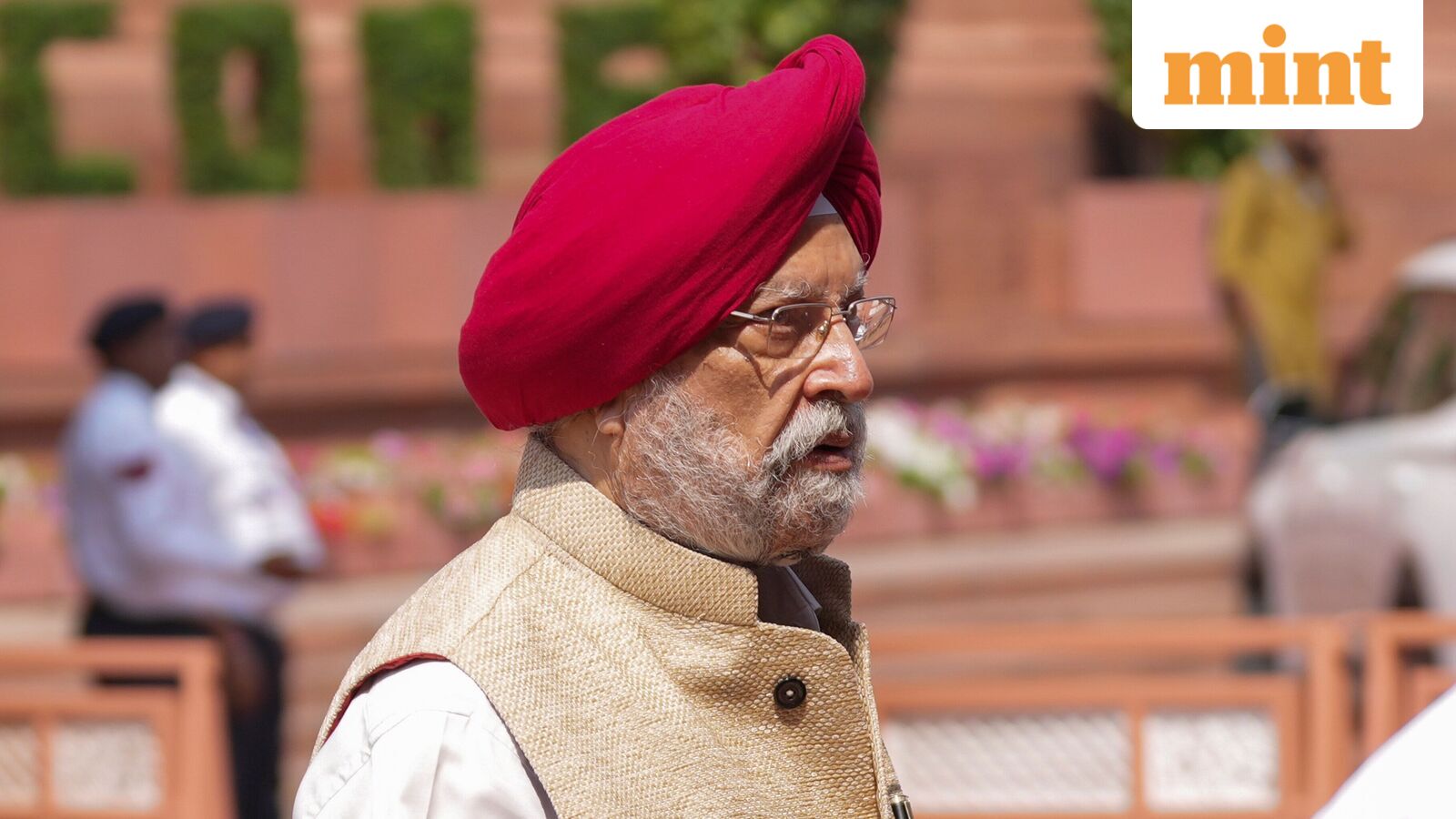
As global oil markets reel from sharp price spikes triggered by the ongoing West Asia conflict, the Indian government has opted to absorb a substantial fiscal burden rather than pass on the full impact to consumers, Petroleum and Natural Gas Minister Hardeep Singh Puri said on Friday.
Framing the decision as a policy trade-off, Puri explained that the Modi government faced a stark choice between raising fuel prices and protecting citizens from global volatility.
“The Modi government had two choices- either increase prices drastically for citizens of Bharat as all other nations have done or bear the brunt on its finances so that Indian citizen is insulated from international volatility.”
Excise duty on petrol and diesel slashed as prices surge globally
The central government has reduced excise duty on petrol and diesel by ₹10 per litre each, a move aimed at cushioning domestic consumers from the steep rise in crude oil prices. The fiscal cost of this intervention is estimated at ₹1.75 lakh crore annually.
Under the revised structure, the special additional excise duty on petrol has been cut from ₹13 to ₹3 per litre, while the levy on diesel has been reduced from ₹10 per litre to zero, according to an official notification.
At the same time, export duties have been reintroduced— ₹21.5 per litre on diesel and ₹29.5 per litre on aviation turbine fuel (ATF)—reviving a policy last seen during the global energy disruptions following the Russia–Ukraine conflict.
Global oil rally drives policy response
International crude prices have surged dramatically in recent weeks, rising from around $70 per barrel to nearly $122 per barrel. The increase has translated into higher fuel costs across global markets, with significant price hikes recorded in Asia, Europe and Africa.
“International crude prices have gone through the roof in the last one month, from around 70 dollars/barrel to around 122 dollars/barrel. Consequently, petrol and diesel prices for consumers have gone up all over the world. Prices have increased by around 30%-50% in South East Asian countries, 30% in North American countries, 20% in Europe and 50% in African countries,” the minister pointed out.
Govt absorbs financial impact to protect consumers, says Puri
Hardeep Puri emphasised that the government has chosen to take a direct hit on its revenues to ensure that fuel prices at the pump remain stable, despite mounting pressure on oil marketing companies.
“Hon’ble Prime Minister Narendra Modi Ji, in keeping with his government’s commitment of the last 4 years since the conflict in Russia-Ukraine started, decided to take a hit on its own finances again to safeguard the Indian citizen.
“The government has taken a huge hit on its taxation revenues to ensure very high losses of oil companies (approximately ₹24 /litre for petrol and ₹30 /litre for diesel) at this time of sky-high international prices are reduced. At the same time, export tax has been levied as international prices of petrol and diesel have skyrocketed and any refinery exporting to foreign nations will have to pay export tax. My gratitude to Hon’ble PM Narendra Modi Ji and Hon’ble FM Nirmala Sitharaman Ji for this very timely, bold and visionary decision!” he said.
The minister added that oil companies had been incurring significant losses due to the gap between international crude prices and frozen retail rates.
Balancing supply stability and fiscal pressure
The excise reduction is also intended to ensure an uninterrupted fuel supply. With crude prices climbing sharply amid the US-Iran war, there were concerns that oil marketing companies could scale back purchases, potentially disrupting availability, according to several media reports.
Notably, while export duties have been reinstated, no windfall tax has been imposed on domestic crude producers such as ONGC—marking a departure from earlier policy responses.
Market strain and industry signals
The strain in the fuel market has already begun to surface. Private retailer Nayara Energy raised petrol and diesel prices earlier this week, while state-owned companies—which dominate nearly 90% of the market—have so far held prices steady.
Retail fuel prices in Delhi remain unchanged at ₹94.77 per litre for petrol and ₹87.67 for diesel at public sector outlets.
Oil shock linked to geopolitical tensions
The surge in crude prices is closely tied to escalating tensions involving the US, Israel and Iran, which have disrupted supply chains and heightened uncertainty in global energy markets. At one point earlier this month, crude prices approached $119 per barrel before moderating slightly.
With India heavily dependent on imported crude, the government’s decision reflects an effort to balance fiscal constraints with the need to shield consumers from external shocks.
#Modi #govt #choices #increase #prices #drastically #Hardeep #Puri #explains #excise #duty #cut #petrol #diesel