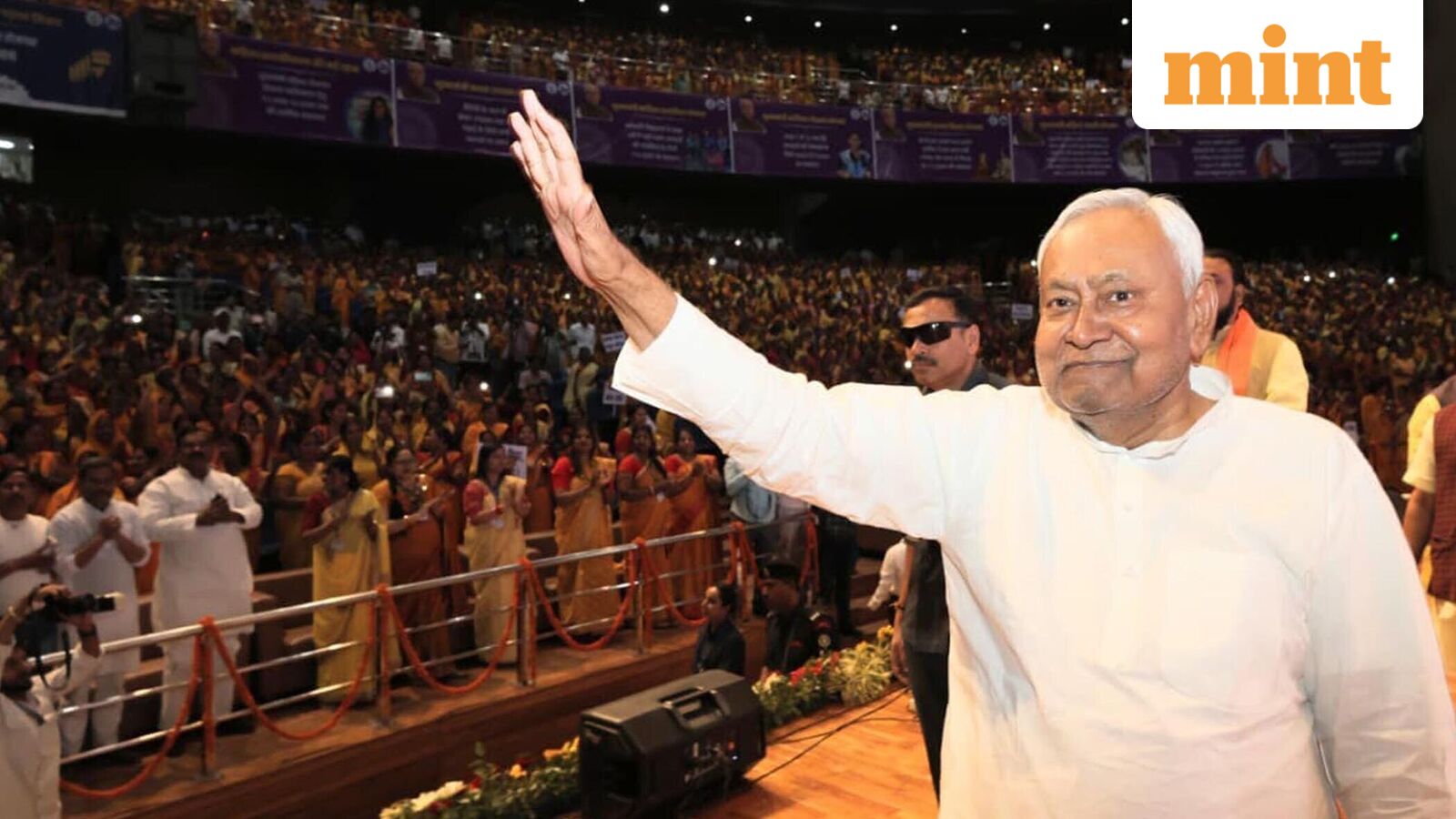
Bihar Chief Minister Nitish Kumar resigned from the state legislative council today, 30 March, weeks after his election to the Rajya Sabha. The move will clear the way for the Janata Dal (United) supremo’s resignation from the chief ministerial post, as he gears up to begin his term in the Rajya Sabha.
Nitish Kumar did not contest therecent Bihar Elections. So he is not a Member of the Legislative Assembly (MLA). He became a Member of the Legislative Council (MLC). A leader has to be a member of either house – a council or assembly – in a state to be a chief minister. The Legislative Council is equivalent to the Rajya Sabha at the state level.
Bihar Legislative Council Chairman Avadhesh Narayan Singh, who also paid a courtesy visit to the Chief Minister in the morning, said he had accepted Nitish Kumar’s resignation. “He has been an invaluable leader of the House and devoted himself to Bihar’s cause,” he added.
Nitish Kumar and Bharatiya Janata Party (BJP) chief Nitin Nabin were elected to the Rajya Sabha on 16 March
And, according to the Prohibition of Simultaneous Membership Rules, 1950 (under Articles 101 and 190 of the Constitution), a member elected to both Parliament and a state legislature must resign from one within 14 days. So the deadline for both leaders to resign from the state legislature was 30 March. Nabin has also resigned as MLA.
Can Nitish Kumar continue to be the CM?
Resigning as MLC or MLA doesn’t mean Nitish ceases to be a chief minister. He is still the chief minister of Bihar, though not a member of the state assembly. And will continue to be for some time, unless he wants to resign.
According to reports, Nitish Kumar is expected to resign as Chief Minister before taking oath in the Rajya Sabha. But there is no official word yet.
On 20 March, Bihar Rural Development Minister Sharwan Kumar said Nitish Kumar can remain in the post for the next six months, despite having been elected to the Rajya Sabha in the recent elections.
What do the rules say?
Article 164(4) of the Constitution of India provides flexibility, allowing a person to serve as Chief Minister or a minister for a period of six months without being a member of the state legislature or council. This clause allows Nitish Kumar to potentially remain in office temporarily, even after transitioning to Parliament, for at least 6 months.
However, with his resignation as an MLC, attention now turns to his successor, as this could herald a significant shift in Bihar’s political landscape after over two decades under his leadership.
Kumar’s return to the national arena could also pave the way for the BJP to have a greater say in the Bihar government and perhaps even stake a claim to the CM’s chair. The frontrunner is Bharatiya Janata Party (BJP) leader and Deputy Chief Minister Samrat Choudhary
A look at Nitish Kumar’s political career
Nitish Kumar’s political career is a masterclass in coalition manoeuvring, marked by a series of high-stakes ideological shifts. Beginning his journey as an MLA in 1985 and later serving as a Union Minister under the Atal Bihari Vajpayee government, he first ascended to the Bihar Chief Minister‘s office in 2005 as an NDA ally.
Since 2013, however, his tenure has been defined by a “revolving door” of alliances, alternating between the BJP and the Mahagathbandhan (RJD and Congress) in 2013, 2017, 2022, and 2024. Despite these frequent realignments, his political survival remains unparalleled; most recently, he secured a fifth electoral landslide in 2025, taking the oath as Chief Minister for a record-breaking tenth time.
What happened in 2025 Bihar Assembly Elections?
Nitish’s transition to Rajya Sabha comes months after the Bharatiya Janata Party (BJP)-led National Democratic Alliance (NDA) won a landslide victory, securing 202 of the 243 seats in the 2025 Bihar Assembly Elections, defeating the Rashtriya Janata Dal (RJD)-led Mahagathbandhan (MGB), which secured just 35 seats.
For the first time, the BJP became the single-largest party in the Bihar assembly, with 89 seats, followed by the JD(U) with 85 seats.
Bihar minister Sharwan Kumar, also a close confidante of Nitish Kumar, said Bihar may get a CM sometime. “It may be possible this month or next month. Nitish ji has been elected to the Rajya Sabha and the term of the current Rajya Sabha member ends on April 9, so Nitish ji will take oath after that. Once he takes the oath, only then the decision over the formation of government will be taken,” Kumar said.
On 19 March, during the Iftar party of Hindustani Awam Morcha (Secular), its founder and Union Minister Jitan Ram Manjhi also batted for Samrat Choudhary as Chief Minister when asked by reporters.
“Nitish Kumar is a transparent person and he does what he thinks. If he is giving such indications about a leader, it should be understood that he will not back out. I also think that Samrat Choudhary could be the choice of Nitish Kumar for the post of Chief Minister,” Manjhi said.
#Nitish #Kumar #resigns #JDU #chief #stay #Bihar #months #Heres