The LPG cylinder that once arrived like clockwork every three weeks has now become a source of anxiety in group chats across urban India. By early March, the Government had invoked the Essential Commodities Act, increased domestic cylinder prices by ₹60, extended the refill booking cycle from 21 to 25 days, and halted commercial gas supplies in Mumbai, Bengaluru, and Kolkata.
The Chennai Hotel Association warned that nearly 10,000 establishments in Tamil Nadu alone were close to shutting down. The cause is geopolitical: the Strait of Hormuz, through which nearly 90% of India’s LPG imports pass, has been closing due to the conflict that escalated after the joint US-Israel strikes on Iran on February 28. India imports over 60% of its cooking gas, and now that supply line is uncertain.
The numbers bear this out. BigBasket data shows induction cooktops recorded a 5x jump in demand on March 10, escalating to a 30x spike by March 11. Seshu Kumar Tirumala, the platform’s chief buying and merchandising officer, notes that the rest of the kitchen appliance category barely moved beyond its usual growth levels. The surge is almost entirely concentrated around induction.
The demand doesn’t seem speculative either as people are making the switch right now, treating induction as a primary cooking setup rather than a hostel fallback or a power-cut plan B. Here is how to think about that transition, from a student’s rented flat to a family kitchen to a home-run supper club.
The small kitchen: Students, bachelors, couples
If your cooking routine is mainly dal-rice, a sabzi, chai, and weekend eggs, then a single-burner portable induction cooktop is all you need. The Prestige PIC 20.0 (1600W, about ₹1,800) is a safe, reliable choice, with preset modes for pressure cooking, dosa, chapati, and curry, along with a standard 6A plug that won’t trip questionable PG wiring.
For faster heating and better searing, the Philips Viva Collection HD4928 (2100W, just under ₹3,000) boils a litre of water in about four minutes and features a useful pause button. The budget option is the Pigeon Rapido Sleek (1800W, around ₹1,400), available on Blinkit and Zepto right now if your cylinder is running low. It has eight presets, auto shut-off, and no frills. It’s the Maruti Alto of induction cooktops, and there’s no shame in that.
One portable unit, one good pressure cooker. Under ₹5,000 covers 90% of a single person’s or a couple’s daily cooking.
The family kitchen
A family of four or more needs to cook multiple dishes simultaneously. There are three options. The simplest is to buy two separate portable units: one with higher wattage for pressure cooking and another with lower wattage for simmering. Total cost ranges from ₹3,000 to ₹6,000. This offers flexibility and a backup, but you’ll need two power outlets on different circuits and enough counter space. Check your wiring before buying; older buildings with 15A mains might struggle to run both units at once.
The Prestige PDIC 3.0 double-burner (₹5,500 to ₹8,000) is the most notable single-unit option, featuring a 2000W main zone and a 1200W secondary zone. The preset Indian menus match Prestige’s single-burner models, and the keep-warm function is very helpful for families that eat at different times. However, Amazon reviews report glass tops cracking under heavy use, with some cracks appearing within just a few months.
Buy from a retailer with a reliable return policy and register the warranty immediately. Consider it a dependable workhorse for two to three years, rather than a lifetime investment.
For a permanent upgrade, built-in induction cooktops from Elica, Kaff, or Bosch start at around ₹20,000 and go over ₹50,000 for models with flexi-zone cooking and boost modes. Installation requires a dedicated 32A electrical line, so you’ll need to hire an electrician. Once installed, you get precise temperature control on a surface that wipes clean in seconds. The whole setup starts to feel less like a workaround and more like something you actually chose.
The working kitchen: Cloud kitchens, supper clubs
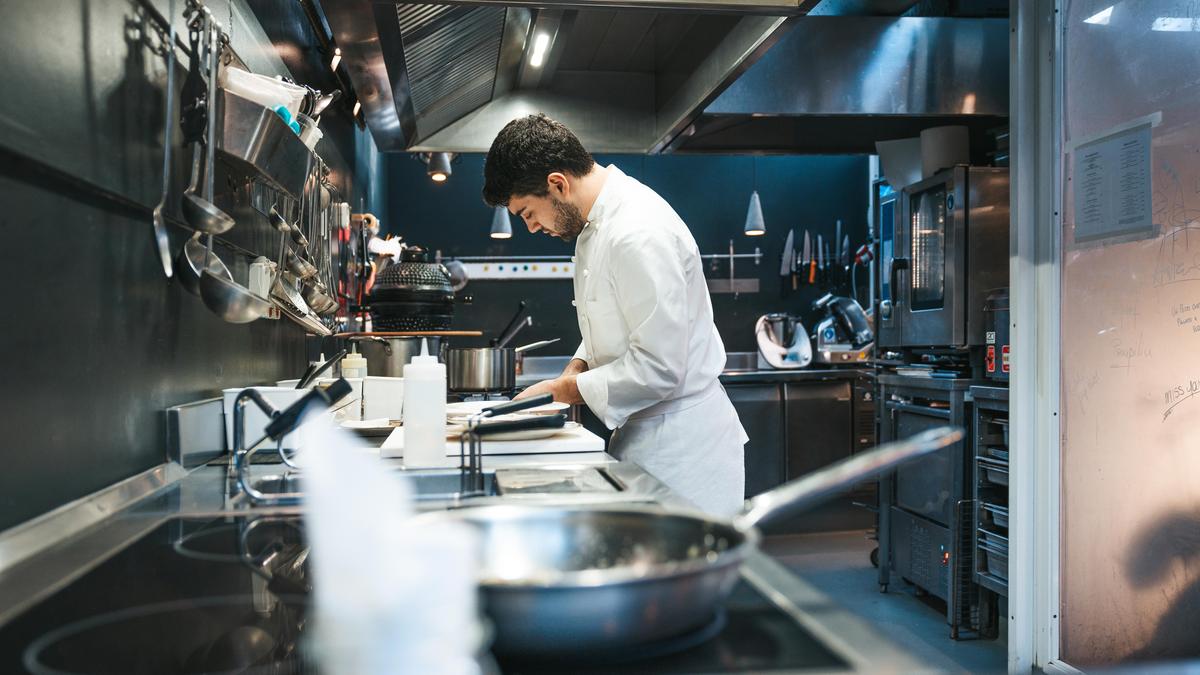
Domestic cooktops are designed for intermittent use. They heat up, cook a meal, then cool down. If you’re running a supper club or a solo cloud kitchen, you need equipment capable of sustained high-heat operation over hours. Brands like NuFlame, Livecook, and BlendArt make 3500W commercial portable induction units (₹15,000 to ₹25,000) that connect to 15A or 16A outlets and can handle large kadais, stock pots, and continuous wok work. The temperature range extends from 60 to 240 degrees Celsius with digital timer controls. For a weekend supper club serving 15 to 20 guests, one of these paired with a domestic unit for sides creates a practical two-burner setup.
Cloud kitchens with daily volume should consider 5kW standing ranges from NuFlame or Lorman, starting around ₹70,000. The main advantage beyond power is safety: no open flame means lower fire risk, reduced insurance premiums, and lighter ventilation needs. In a small rented space operated as a cloud kitchen, these are significant operational benefits.
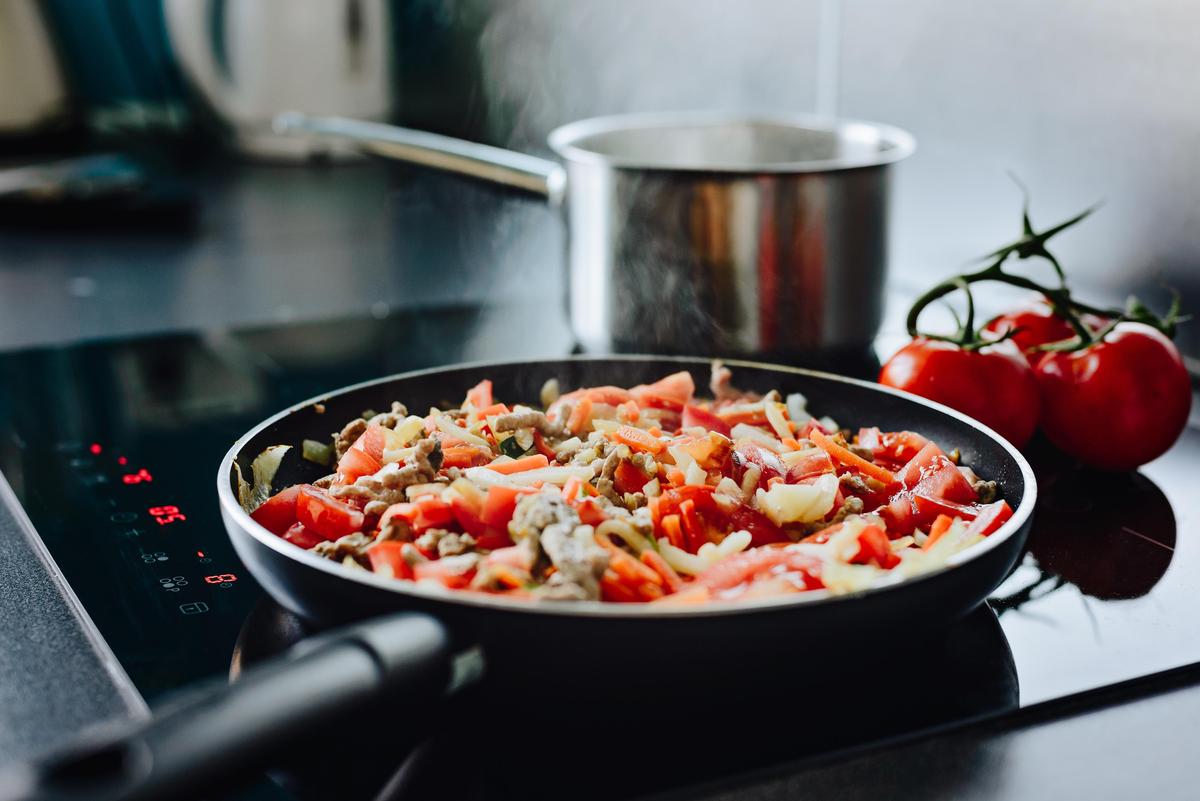
Frying minced pork with vegetables on olive oil. Frying pan on induction cooker. Preparing spaghetti bolognese sauce for dinner Inducation
| Photo Credit:
Getty Images/iStock djedzura
The cookware question
Induction heats cookware directly through a magnetic field. If a fridge magnet sticks to the bottom of your pan, it works. If it doesn’t, it won’t heat at all. Cast iron, magnetic stainless steel (SS430), and carbon steel all work. Pure aluminium, copper-bottom, and glass cookware do not. If you have a favorite aluminium kadai from your grandmother, it is time to accept that it belongs on the shelf. Induction adapter discs exist, but they are inefficient and defeat the purpose of induction’s speed.
You don’t need imported cookware to cook well on induction. Vinod’s Platinum Triply range starts at around ₹1,200 for a small kadai. Stahl has built its entire line around tri-ply induction cookware. Hawkins makes tri-ply deep-fry pans. The Indus Valley offers a full range at competitive prices. Blinkit and Zepto stock Prestige and Pigeon induction-compatible pressure cookers and basic stainless steel pans, enough to get cooking the same day. The real finds are on Amazon and Flipkart during late-night flash sales, where tri-ply sets routinely drop 30% to 50% t off between 10pm and midnight. Keep a wishlist loaded, and notifications turned on. Three pieces cover the essentials: a kadai, a flat tawa, and an induction-friendly pressure cooker.
Everything else is a bonus.
If you already have enameled cast iron from Le Creuset or Staub, you’ll find it works perfectly on induction cooktops. However, that’s a nice bonus rather than a must-have.
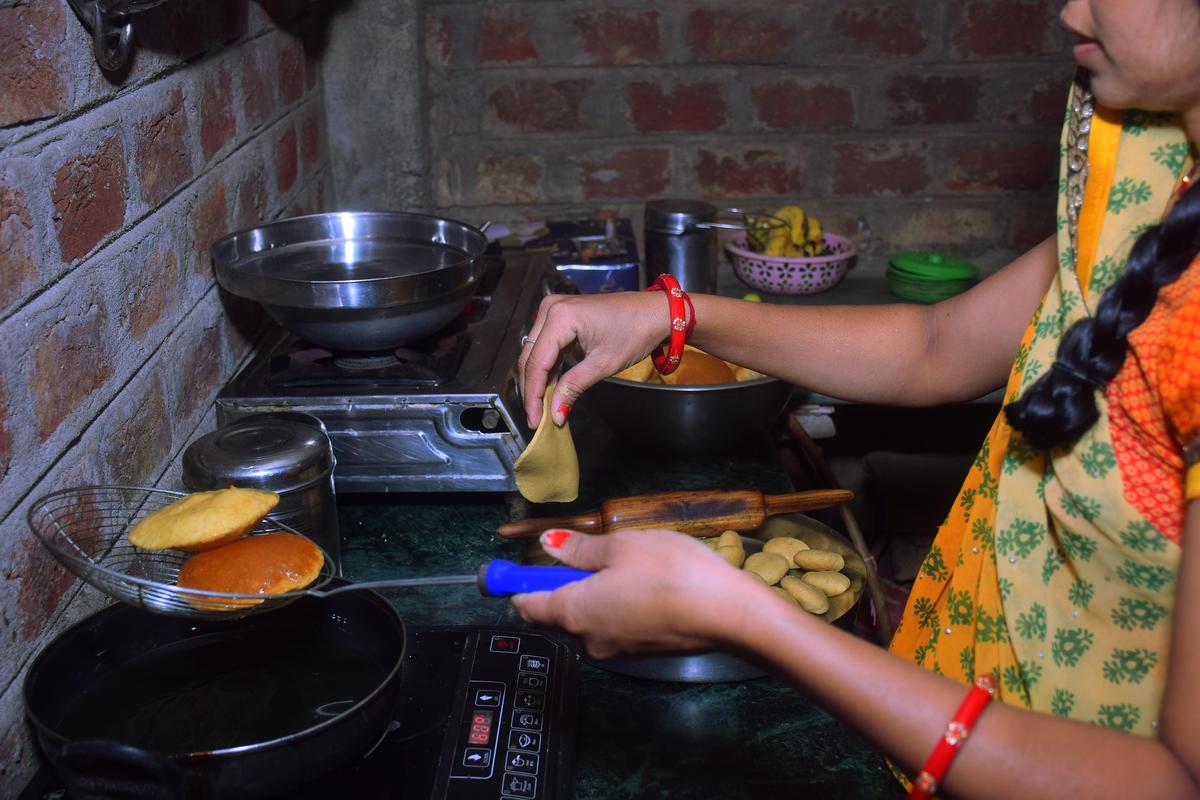
modern black induction stove, Woman standing in kitchen cooking food with spoon, fried chapati(puri) Inducation
| Photo Credit:
Getty Images/iStock Tofan Singh
Maintenance, briefly
Wipe the glass surface after each use with a soft, damp cloth. Never use steel wool. Lift your pots instead of dragging them, especially cast iron, which can scratch the glass instantly. This is the most common cause of damaged cooktops. Use only flat-bottomed cookware; warped pans heat unevenly and can cause error codes. A 2100W cooktop draws about 10 amps, so two units on the same circuit might trip a 15A breaker. When setting up multiple units, have an electrician check your wiring and, if possible, run a dedicated line. Keep the rear vents unobstructed, as induction cooktops have internal fans that need clearance. Do not leave an empty pan on an active zone; the auto shut-off is a safety feature, not something to rely on.
The bigger picture
India’s dependence on imported LPG has been a known vulnerability for years. The current crisis has dragged it from policy papers to the kitchen counter. Whether the Strait of Hormuz reopens in weeks or months, the structural lesson holds: a cooking system built on a single imported fuel, shipped through a single chokepoint, was always going to crack under pressure.
Induction will not replicate everything gas does. It cannot char a roti the way an open flame can. It depends on reliable electricity, which large parts of the country still cannot take for granted. It requires cookware most households do not yet own. But for the dal, the rice, the pressure-cooked rajma, the morning chai, the kid’s evening Maggi, it works.
It works well. And unlike your next LPG refill, it does not depend on what is happening in the Strait of Hormuz.
The best time to have made the switch was before the crisis. The second-best time isnow.
Prices are approximate and based on online listings as of March 2026. Availability may vary by city and platform.
#cylinder #doesnt #show