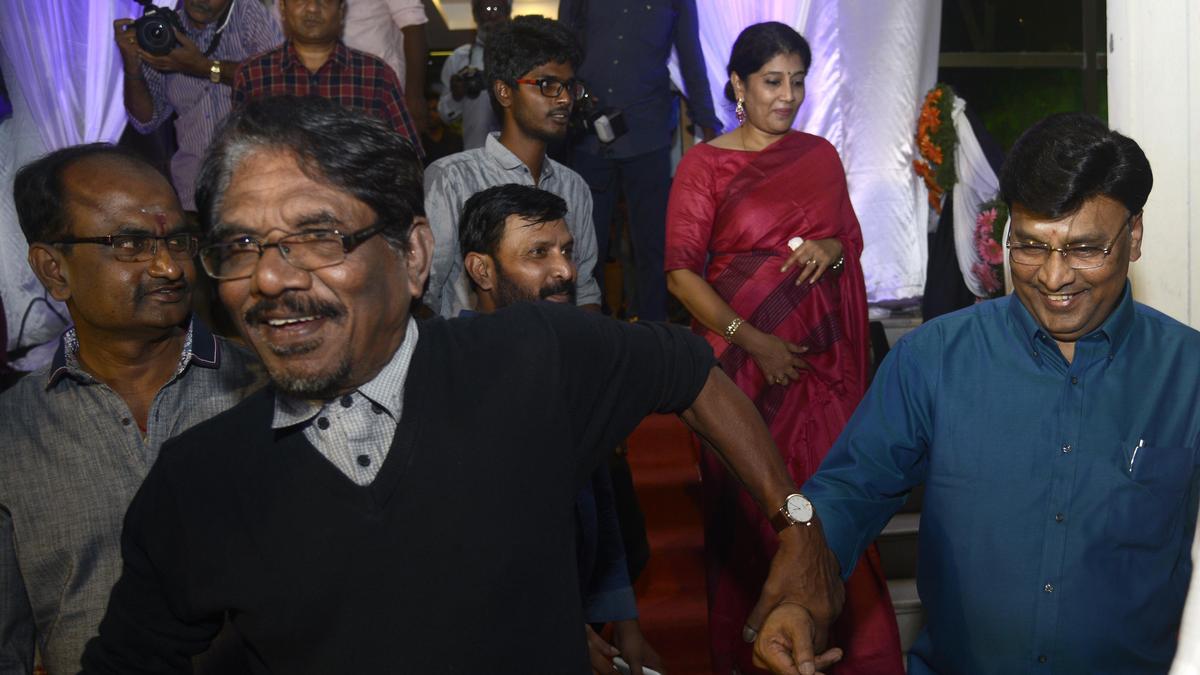

‘Bhagyaraj was an associate of Bharathiraja. Together, they transformed the grammar of Tamil cinema’
| Photo Credit: The Hindu
I vividly remember the night I went to watch K. Bhagyaraj’s Thooral Ninnu Pochu. I sat on the carrier of my cousin’s bicycle as he pedalled against the stiff wind blowing from Putheri Lake in Kanniyakumari district. That night, we slept on the veranda of my cousin’s neighbour’s house and woke up to the scorching morning sun beating down on our faces, with the film still playing in my mind. Its unforgettable songs — especially Erikkarai Poongatre — have continued to echo in my ears even after decades.
The day Bhagyaraj died, I was in Thukkachi, a village near Kumbakonam. My Chief of Bureau, Ramya Kannan, alerted me to the news. I was stunned. Barely two weeks earlier, another of my favourite filmmakers, Bharathiraja, had passed away.
Bhagyaraj was an associate of Bharathiraja. Together, they transformed the grammar of Tamil cinema. Writing Bhagyaraj’s obituary — and, before that, Bharathiraja’s — came naturally to me because I had admired their work for decades. As a director, actor, scriptwriter, and dialogue writer, Bhagyaraj broke almost every convention of commercial filmmaking.
A gifted storyteller with an instinctive understanding of human relationships, he dethroned the larger-than-life hero and replaced him with the ordinary man from the street. He proved that charisma did not depend on a commanding screen presence or exaggerated heroics. Wit, intelligence, vulnerability and self-deprecating humour could be just as compelling. His films showed that an unassuming young man could win a woman’s heart through ingenuity rather than machismo.
In Indru Poi Naalai Vaa, he and his friends are willing to do almost anything to win the affection of the heroine. Bhagyaraj’s character accompanies the heroine’s mother to the ration shop in the hope of getting closer to her family and even sketches a donkey because its milk is believed to cure the heroine’s younger sister’s ailment. Such scenes became believable because of his extraordinary sense of humour and impeccable comic timing.
Bharathiraja, by contrast, dealt with more serious themes, capturing the emotional landscape of rural Tamil Nadu with remarkable sensitivity. His films were marked by dialogues that lingered long after the curtains came down. One such line that resonates with me is Sridevi’s poignant declaration to Kamal Haasan in the closing moments of 16 Vayathinile: “Indha Mayilu Unakkagave Eppavume Kaathiruppa (will always be waiting for you).”
In Bhagyaraj’s Suvar Illatha Chithirangal, the comedy scenes featuring Kallapetti Singaram and Goundamani, spoken in authentic Kongu dialect, testify to his deep understanding of society. It was from that film that I learnt the word siluvanam, used to describe a naïve person. Equally unforgettable is the street-side tailor’s lament: “Veppankaikku kood irandu kaaka varuthu; enakku kadankaranthan vaaran (At least a few crows visit the neem tree for its fruits, but I am visited only by money lenders).”
I watched most of the films of Bharathiraja and Bhagyaraj in touring talkies. Those humble theatres, the crackling projector, the smell of the earth spread on the floor, and the collective excitement of the audience whenever a punch dialogue was delivered made watching a film an unforgettable experience.
During the summer temple festivals in our villages, naiyandi melam troupes would often play songs from Bhagyaraj’s films. Even today, whenever I come across such performances, I request them to play Mookuthi Poomele from Mouna Geethangal and Kadhal Vaibhogame from Suvar Illatha Chithirangal.
I watched Mouna Geethangal with a young girl, her father and her brother. By then, I had begun wearing spectacles like the child character in the film and was constantly ridiculed by my classmates. Yet I cherish that film for a very different reason. The girl who watched it with me would, years later, become my wife.
Published – July 03, 2026 01:10 am IST
#Bhagyaraj #Bharathiraja #memories #left