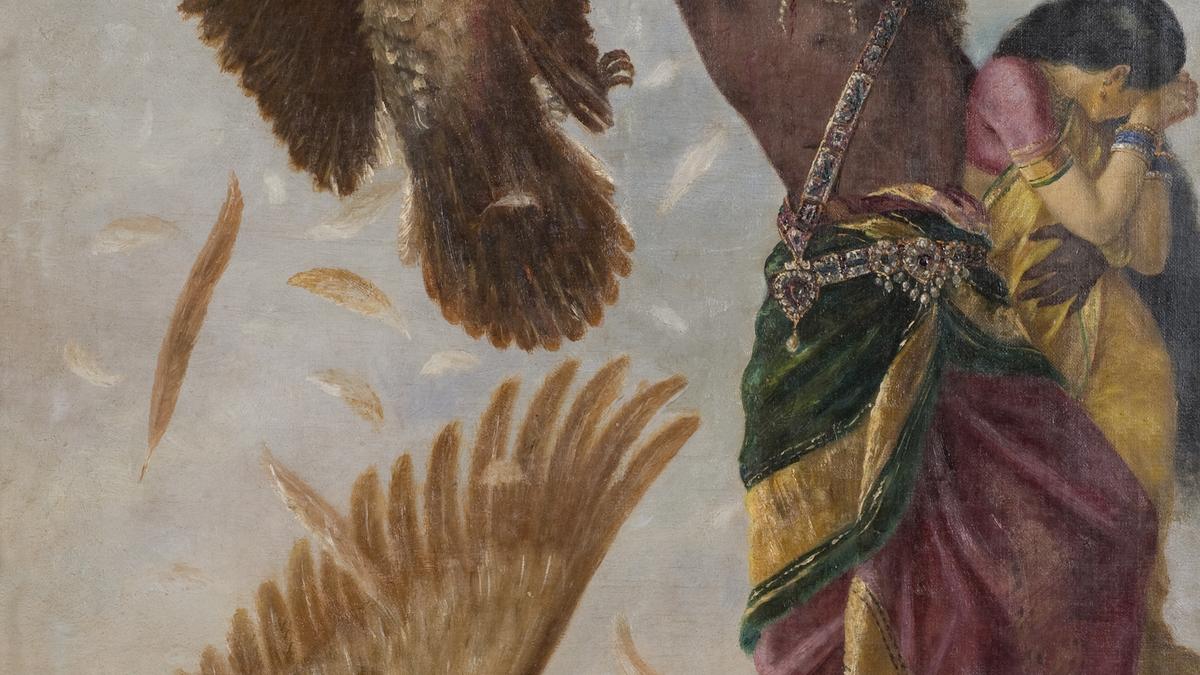

Jatayu Vadham by Raja Ravi Varma
| Photo Credit: SPECIAL ARRANGEMENT
Raja Ravi Varma has been in the news this year for many ‘expensive’ reasons, most notably after his Yashoda and Krishna sold for a record ₹167.2 crore. Yet, beyond auction houses and gallery displays, the celebrated artist’s works have been at the centre of public debate, legal disputes, and cultural conversations. An upcoming talk by advocate, author, and adjunct professor at the National Institute of Advanced Studies (IISc), Bengaluru, Ganesh V Shivaswamy explores the lesser-known legacy, examining how Ravi Varma’s art reached far beyond royal patrons and collectors to engage wider public discussion.

Titled Raja Ravi Varma’s Ravana in Conflict and Controversy, the talk focusses on the artist’s iconic deception of Ravana and the controversies it sparked over the decades. The talk traces how the image became entangled in court cases, discussions on scientific evidence, Government acquisition of cultural objects, and questions of authenticity and public memory.
“Generally, the greater legacy belongs to Rama. Ravana has always had the lesser narrative around him, not because he is a lesser character, but because there’s a lot to debate around him. That’s what makes him so interesting to explore,” says Ganesh.

Ganesh V Shivaswamy
| Photo Credit:
SPECIAL ARRANGEMENT
A large part of the talk revolves around how the interdisciplinary intersection of law and art informs the study of cultural history. Ganesh explains that the work of a historian and the work of a lawyer are fundamentally the same. “It is understood that liberal art is a space of expression, while law is considered a space of regulation and suppression. But in this talk you will notice that one propels another into thinking and deliberating that at some point it starts working together,” he says.

One of the cases to be discussed in the talk centres on a petition heard by the Kerala High Court between 2011 and 2012, in which the petitioners sought to have all of Raja Ravi Varma’s paintings acquired by the Centre under the Antiquities and Art Treasures Act. Justice Chelameswar declined the plea, holding that the Government could not indiscriminately acquire cultural objects. Ganesh points out that the judgment became an important milestone in how legal frameworks shape the preservation and ownership of art.
Ganesh also highlights the case of the Roerich estate (Svetoslav Roerich and Devika Rani Roerich) in Bengaluru. The Government of Karnataka acquired the estate and its paintings in the early 1990s on the pretext that the couple had no heir, stating that the acquisition was intended to create a museum for the general public. However, in 2026, the Government has done nothing to build the museum; the paintings remain locked away in storage, and the estate was instead slated to become an eco-tourism hub.

“The question of Government control as cultural custodian is a huge question which comes up in the talk,” says Ganesh. “As much as I tell you this is what happened, I dont know all the answers. A big part of the talk is asking the audience, ‘what do you think?,’” adds Ganesh.
By weaving together history, law, politics and questions of cultural ownership, the talk invites audiences to reconsider how works of art continue to shape public life long after they have been painted.
Raja Ravi Varma’s Ravana in Conflict and Controversy will take place on July 19, at The Lab, T Nagar, Chennai. Entry is free and open to all. RSVP on 99406 20268. .
Published – July 15, 2026 05:04 pm IST
#Raja #Ravi #Varmas #Ravana #Ganesh #Shivaswamys #talk #painting