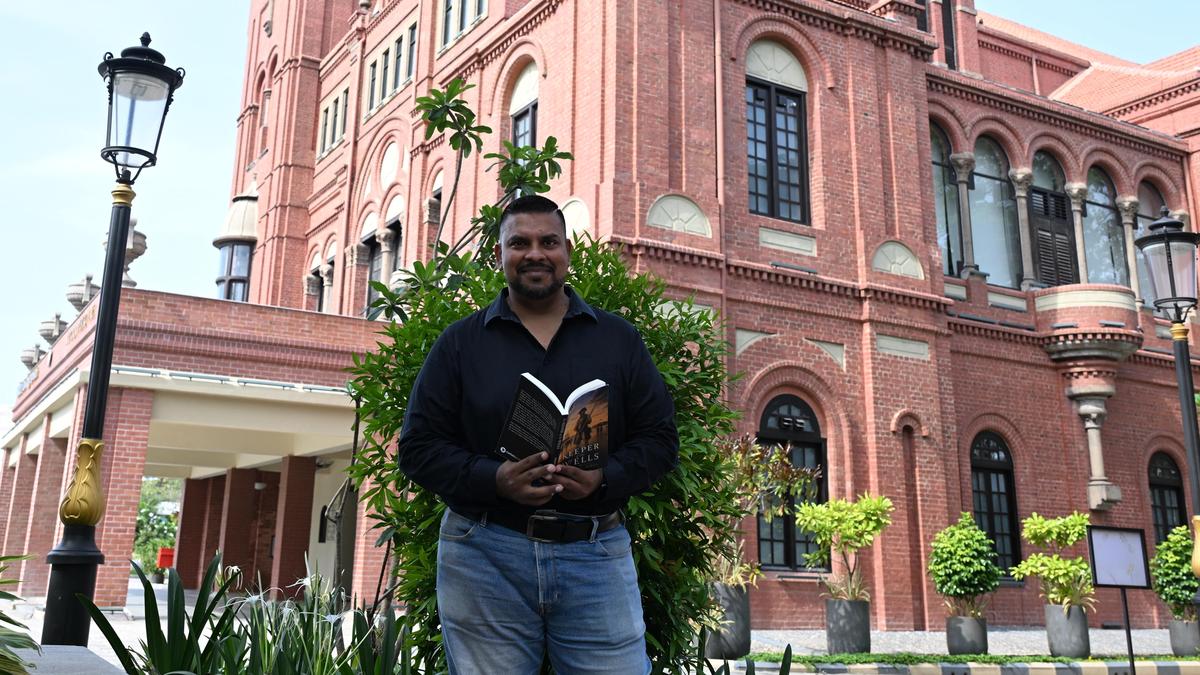
On a searing July morning I walk among rows of birds-of-paradise lining the pathways around the recently-renovated Victoria Public Hall, a stirring example of Romanesque architecture. It is not often that you interview an author at a place that also features in the opening pages of his debut novel.
Zhayynn James’s The Keeper of the Wells, published by Notion Press, is a centuries-spanning, continent-traversing family saga that opens a hundred years ago in colonial Madras, travels to Europe and returns to the city at a time when it was still an outpost of the Empire on the eve of the Second Anglo-Mysore War (1780-84). What strings this kaleidoscopic narrative — of European and Indian powers at play, the battle for the Carnatic, the lives of those at Fort St George and outside its ramparts — is the story of an Irishman John Nicholas, his descendants, and the legacy they were bequeathed by the East India Company for saving the inhabitants of the city from a cruel fate.
Zhayynn, a second-generation landscape architect and award-winning wildlife photographer who has been featured in National Geographic and BBC Wildlife Magazine, among others, was raised in Adambakkam on the outskirts of Chennai. “It was a childhood spent running wild among sparrows, frogs and trees, peppered with a robust dose of Anglo-Indian optimism,” says Zhayynn, who is an old boy of St Bede’s, Madras Christian College, and the University of New South Wales.
But all through those years, Zhayynn knew there was more to his family genealogy than just mixed race parentage. “My mother Marlene was a Nicholas and it was her parents who told me stories of an Irishman who saved Madras from the machinations of Hyder Ali and how we were descended from that stock. I’m the eighth generation. That story resurrected itself during family get-togethers and all the more during funerals when various Nicholases were constantly being introduced and identified. It was at my grand-aunt Kitty’s funeral that I discovered the inextricable link the Nicholas family shared with an old Madras neighbourhood — the Seven Wells.”

The last custodian of the Seven Wells, Evelyn Nicholas, with his wife Millicent and their children Connie, Gwen and Harold in 1916 at the Seven Wells compound driveway.
| Photo Credit:
Courtesy Zhayynn James
When Zhayynn was in his twenties he realised that the distance between the older generation that remembered these stories, and his generation that struggles to remember it, was widening and that this legacy may not even be a footnote in the history of Chennai unless he did something about it.
Three serendipitous occurrences led him to write the book — the first was his meeting with that renowned old Madras hand and chronicler, S Muthiah, who pointed him in the direction of three books — HD Love’s Vestiges of Old Madras, JC Molony’s A Book of South India and his own Madras Rediscovered that historically mentioned the Nicholas family as the Custodians of the Seven Wells, a locality in North Madras where wells were sunk to supply fresh water to Fort St George, making it the first piped water supply in British India. The second was discovering the Nicholas square at the St Roque’s Cemetery in Washermanpet where generations of Nicholases had been buried and are still laid to rest. The third was Zhayynn’s wife Vaishali’s constant encouragement — she gifted him a DSLR so that he could pursue photography and kept him company while he researched on the family, pushing him to complete the book in time for his 50th birthday.

Zhayynn James, author of ‘The Keeper of the Wells’, speaks at the launch of the book at Victoria Public Hall. (From left) Historian V Sriram, publisher-filmmaker Harry MacLure, writer Ranjitha Ashok, and anchor Sujatha Giri.
| Photo Credit:
VELANKANNI RAJ B
At the launch of the book at Victoria Public Hall with a galaxy of panellists that included historian Sriram V, publisher-writer-filmmaker Harry MacLure and writer Ranjitha Ashok, with Sujatha Giri hosting the evening, Sriram spoke about “how important it is to have a book like this. Creating a romantic interest in history will draw more readers to it. From here they may go onto research but ‘faction’ (a portmanteau of fact and fiction) books such as these ignite the imagination. Nicholas, as per Molony, saved the water supply during ‘the stormy days of Hyder Ali’s conquest and was named Custodian of the Seven Wells’. Not just that, the title and emoluments that went with it were bestowed on the family for 125 years”.
While Harry underlined the Anglo-Indian contribution to India and Ranjitha drew attention to the incorporating of family moments within a historical framework, Zhayynn spoke of how after living with the story for decades he finally put pen to paper in October 2025 and finished the book in April this year.

Zhayyn says that a fascinating story that has been passed down generations is of how John Nicholas etched the map of a fort where he was held prisoner on his thumb nail. Influenced by the writings of Bernard Cornwell and Louis L’Amour who both wrote of swashbuckling heroes and damsels in distress, Zhayyn says he wove in a love story because “Madras was a cosmopolitan city even in the 1700s with its mix of Luso-Indians, British, Telugus and Tamils. Beyond the city on the brink of war I wanted a nuanced and layered love story”.

The book
| Photo Credit:
Zhayynn James
The book written at a racy pace but with a touch of old-world charm and a vocabulary that seems to have fallen off the map, has many descriptive scenarios worth remembering. The battle scenes are a masterclass in detail and atmosphere.
The book opens in a gentler time but its narrative energy comes from Zhayynn’s deep research — combing through church records with his mother in tow: at St Francis Xavier’s Church, Broadway, and St Mary’s Co-Cathedral, Armenian Street, research at the British Library, London, and trawling the Internet. “The oldest physical record was from the 1840s. I also am indebted to all the Nicholases, about 40-odd now, around the world. Nigel, a distant cousin, whom I discovered in the course of my research, willingly shared the information he had gathered. And I knew I was on the right track when every date mentioned matched with history. However, the Indian names of the people they married were just entered as Indo-Brit.”

The last custodian of the Seven Wells, Evelyn Nicholas, and his wife Millicent at the Seven Wells compound circa 1914
| Photo Credit:
Courtesy Zhayynn James
Zhayynn wrote in cafes, between breaks at work, and late into the night. He also wrote with the inherited DNA of a man who had arrived on these shores looking for escape, survival and redemption.
As for Seven Wells, it still stands, shrouded in shrubbery with only one functioning well. But it survives — as a busy neighbourhood, a pincode, a family saga, a book, and one man’s record of the role his family played in shaping the history of Madras.
Published – July 15, 2026 06:10 pm IST
#AngloIndian #family #Chennai #custodians #Wells