For the better part of the last century, Tokyo has industrialised almost every corner of Japanese cultural life without entirely surrendering the older rituals that made the city worth mythologising in the first place. This explains why we can leave the neon sprawl of Shinjuku crossing, walk barely fifteen minutes through a forest of convenience stores, karaoke parlours and office towers, and arrive at Suehiro-tei, one of the country’s oldest surviving yose theatres, where a lone storyteller still commands an audience armed with nothing beyond a folding fan, a hand towel and enough vocal dexterity to persuade several hundred strangers that they are watching an entire cast instead of a single performer seated permanently on a cushion.

This storied Japanese tradition is called rakugo, a form of comic and dramatic storytelling whose modern manifestation emerged during Japan’s Edo period between the seventeenth and nineteenth centuries. Its practitioners, known as rakugoka, spend decades climbing an apprenticeship hierarchy before earning the coveted title of shin’uchi — the highest professional rank that grants both prestige and the right to train disciples. But rakugo is also the last place you would expect Weekly Shonen Jump, the manga magazine responsible for industrial-scale pop-cultural institutions such as Dragon Ball, One Piece and Jujutsu Kaisen, to discover its next competitive shonen blockbuster.
The manga created by writer Yuki Suenaga and illustrator Takamasa Moue debuted in 2022 after the former realised that rakugo possessed something conventional stand-up lacked. This was a centuries-old institutional ecosystem where artistic excellence could be measured, disputed and inherited through formal ranks, and that insight survives the transition to television with remarkable efficacy in Zexcs’ 2026 anime adaptation, helmed by Ayumu Watanabe.
Akane-banashi (Japanese)
Director: Ayumu Watanabe
Cast: Anna Nagase, Takuya Eguchi, Rie Takahashi, Jun Fukuyama, Nobunaga Shimazaki, Chiaki Kobayashi, Yohei Azakami, Seiichiro Yamashita, Masaki Terasoma
Episodes: 12
Runtime: 25 minutes
Storyline: After her father is expelled from the world of professional rakugo, Akane Osaki vows to master the traditional Japanese art of solo storytelling, determined to restore his honor as she navigates the fiercely competitive rakugo world
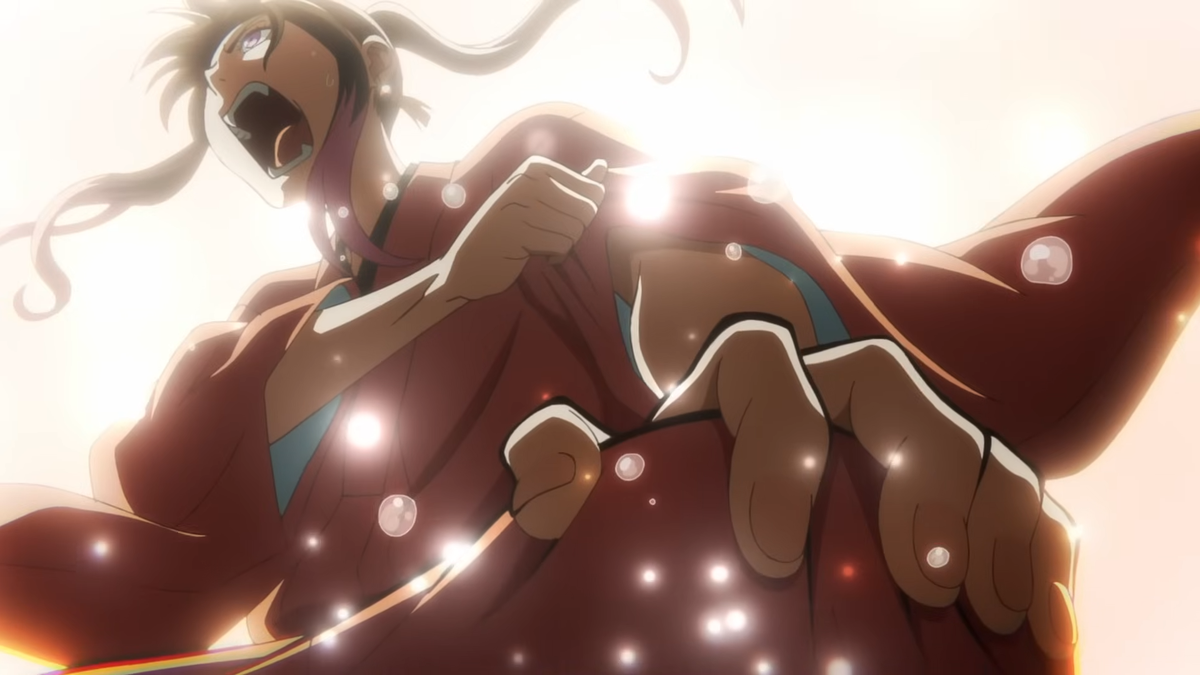
The series centres the titular teenage rakugo prodigy Akane Osaki, as she sets out to reclaim her disgraced father’s legacy. The opening episode follows her father Shinta Arakawa as his long-awaited promotion to shin’uchi ends in inexplicable expulsion at the hands of the Arakawa school’s merciless master, Issho, leaving his daughter to inherit the unanswered question that destroyed his career. Watanabe’s adaptation seizes upon this emotional residue through one of its most inspired departures from the manga, overlaying Shinta’s climactic performance with Akane’s primary-school essay proclaiming her father the person she admires most. As her childish certainty that his promotion will fulfil both their dreams collides with his mounting despair on stage, the sequence accomplishes something uniquely suited to animation by visualising the inheritance binding father and daughter, and reframing Akane’s journey as one that began years before she ever resolved to become a rakugoka herself.
A seven-year time skip finally hands the microphone to Akane herself, although Suenaga immediately swerves around one of battle shonen’s most exhausted habits of confusing prolific aptitude with personality. She enters high school after years of clandestine tutelage under her father’s former master, Shiguma Arakawa, armed with at least three training arcs, worth instinctive command over rakugo. But her defining trait is an almost impossible absence of social vanity. Akane has the rare gift of making everybody around her feel worth listening to. She approaches every interaction with the same openness she brings to the stage, asking questions with genuine curiosity and accepting criticism without wounded pride. She is quite simply, just terrific company.

A still from ‘Akane-banashi’
| Photo Credit:
Netflix
At her new apprenticeship, Shiguma’s current disciples quickly expose the first illusion Akane mistakes for her prowess. Following an underwhelming performance at a neighbourhood venue, one earnest senpai, Kyoji, pinpoints a blind spot no amount of technical fluency can compensate for. She has been performing at audiences for so long that she has almost forgotten to perform for them. Kyoji’s corrective belongs in the pedagogical hall of fame alongside Mr Miyagi, as he banishes her to work at a neighbourhood izakaya, where, like karate, rakugo too gradually emerges as another branch of service work, built upon the invisible choreography of anticipation and stewardship. This reaches fruition during Akane’s performance at a retirement home, where she finally abandons the universalist fantasy that audiences exist as infinitely recyclable consumers waiting to receive identical art. And here, the series slips one of its most persuasive ideas: every great storyteller begins by becoming an even better listener.
Later, when Akane announces that she intends to become a professional rakugoka, her homeroom teacher responds with pragmatic skepticism. Rakugo is a shrinking profession built upon irregular income and dwindling audiences, capable of evaporating decades of work through a single opaque decision, as Shinta’s fate has already demonstrated. And so, the teacher is asking exactly the questions a responsible adult should ask somebody staking their future upon the arts. Though Akane ultimately wins her over, the anime acknowledges that passion alone has never paid anybody’s rent while still insisting that extraordinary commitment often deserves extraordinary faith.

The same maturity informs the eventual Karaku Cup — an amateur rakugo competition where the winner earns an audience with Issho — easily the most exhilarating tournament arc I’ve encountered in years. Suenaga steals battle shonen’s favourite narrative trope almost wholesale, only to swap power systems for performance theory. Akane’s young rivals are Karashi, a rakugoka notorious for transplanting centuries-old stories into contemporary settings; and professional voice actor Hikaru Kouragi, who relies on years of theatrical training to produce polished dramatic performances. Meanwhile, Akane, guided by another senpai, Koguma, learns that originality is impossible without first understanding the tradition she hopes to inherit.
Watanabe’s direction and the series’ remarkable editing deserve enormous credit for making those performances compulsively watchable even for viewers encountering rakugo for the first time. Sports anime like Haikyuu!!! or Slam Dunk have long specialised in persuading us to care deeply about activities we never previously considered watching, and Akane-banashi performs an almost identical sleight of hand. Somewhere around the fifteenth rendition of the notoriously tongue-twisting “Jugemu”, I realised the anime had unsuspectingly tricked me into memorising a centuries-old rakugo routine (which is probably exactly the kind of cultural osmosis the adaptation has been engineering all along).

A still from ‘Akane-banashi’
| Photo Credit:
Netflix
More than anything else, however, the adaptation is a joyous celebration of the human voice itself. Every performance asks actors to conjure entire casts through nothing but cadence, breath, rhythm, and microscopic changes in vocal texture, creating this fascinating meta-spectacle of listening to voice actors perform stories about performers whose entire craft depends upon voice acting. The cast rises magnificently to the challenge, but Anna Nagase’s work as Akane borders on revelatory, viciously shifting between adolescent exuberance and disciplined theatrical control without ever allowing either register to swallow the other. It is difficult to imagine a more demanding voice acting assignment from this year, and is comfortably among the year’s best.

Akane-banashi places extraordinary faith in the proposition that four-hundred-year-old stories still possess enough imaginative voltage to overcome this generation’s chopped attention spans. Against all commercial logic, it works beautifully. I cannot wait to hear what story Akane chooses to tell next.
Akane-banashi is currently available to stream on Netflix
Published – June 30, 2026 05:27 pm IST
#Akanebanashi #series #review #Jubilant #rakugo #revival #sleeper #shonen #hit