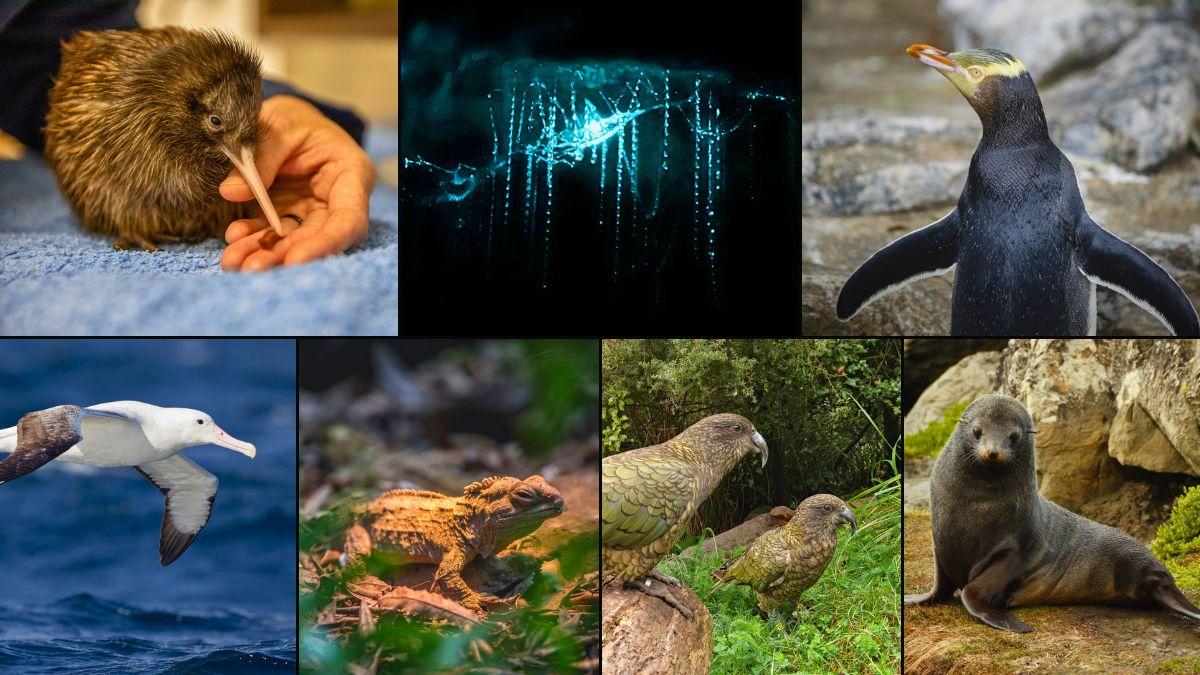
New Zealand’s wildlife evolved in prolonged isolation after the ancient supercontinent Gondwana broke apart roughly 85 million years ago, leaving the islands without terrestrial mammals for millions of years and allowing birds, reptiles and insects to take up ecological roles that elsewhere belonged to predators, grazers and scavengers. They survive today in fragments across the country.
“Anyone that comes here, there’s an innate desire and aspiration for Nature to thrive. Or you wouldn’t be here.” Bodie Tihoi Taylor says this while standing inside Sanctuary Mountain Maungatautari, a 3,400-hectare ecological sanctuary in the Waikato region of the North Island, where native birds now outnumber invasive predators because humans built a 47-kilometre fence around an extinct volcano and removed nearly every mammalian threat inside it.
Bodie, a cultural educator and iwi representative who leads the sanctuary’s Moa Hunter tours, speaks about conservation as a consequence of history. For Māori communities, the country’s wildlife is inseparable from the memory of what was already lost, and the moa remains central to that history.

Bodie Tihoi Taylor, cultural educator and iwi representative, enters Sanctuary Mountain Maungatautari, New Zealand
| Photo Credit:
Ayaan Paul Chowdhury
Before human settlement, several species of the giant flightless bird dominated New Zealand’s forests and shrublands, with the largest reaching heights of over three metres. Within roughly a century of Polynesian arrival around the 1300s, moa populations collapsed through sustained hunting and habitat pressure, triggering one of the fastest large-animal extinctions in recorded history. The disappearance of the moa also wiped out the Haast’s eagle, the apex predator that depended on them for food.
Conservation across modern New Zealand carries the memory of that ecological rupture because many Māori communities view it as a warning inherited across generations: once a species disappears from these islands, evolutionary isolation means it is gone forever. Today, the push to protect and preserve exists partly because nobody wants the next generation of native wildlife to survive only as bones in a museum.

That ecological history now shapes modern tourism as much as it shapes conservation policy. Across Aotearoa New Zealand, fenced sanctuaries, cave systems, wildlife reserves and coastal rehabilitation projects have become frontlines in a national effort to reverse those waves of extinction. Travelling through the North and South Islands today means moving through places where Māori communities, scientists, tour operators and volunteers are attempting to rebuild ecosystems that settlers dismantled in stages over roughly 700 years.
Rebuilding the mountain
At Sanctuary Mountain Maungatautari, that restoration effort began with the pest-exclusion barrier through which stoats, rats, possums and other feral predators have been systematically removed so threatened birds can survive. Inside the sanctuary, the forest sounds unnervingly alive for visitors accustomed to quieter woods elsewhere in the world.
Bodie frames conservation as a continuation of Māori relationships with land. “I was very fortunate to be brought up in some traditional ways,” Bodie says while guiding us through the ancient forest lined with towering rimu and tawa trees. “Those ways are not taught in classrooms, they’re taught in the bush with the people.”

The canopy inside Sanctuary Mountain Maungatautari, New Zealand
| Photo Credit:
Ayaan Paul Chowdhury
Maungatautari now supports reintroduced populations of takahē, the large flightless rail once feared extinct, alongside tīeke, hihitūī, korimako, pīwakawaka and North Island robins. The sanctuary estimates it now hosts more than 3,000 kiwi within the protected ecosystem. During walks through the forest, guides regularly point out pītoitoi, or New Zealand tomtits, flitting between branches while kākā circle noisily overhead searching for food.

(clockwise from left) the tūī, the korimako, the takahē and the pīwakawaka
| Photo Credit:
Tourism New Zealand
For Bodie, contemporary conservation also involves negotiating the relationship between Indigenous knowledge and modern scientific management. “It’s a sense of responsibility and loyalty and duty,” he says while explaining the Māori concept of “kaitiakitanga”, often translated as guardianship. “There needs to be a balancing between conservation of our modern day and conservation of our ancestral days.” He also talks about land stewardship and the relationship between Māori conservation practices and the settler colonial systems that reshaped ownership across New Zealand after the Treaty of Waitangi was signed in 1840. “It’s only through the eye of the needle that we all come together to be one,” he says, referencing a whakataukī, or traditional Māori proverb, about unification.
Conservation projects in New Zealand increasingly operate through arrangements between iwi groups, government agencies and private trusts after generations of Māori land dispossession under colonial settlement. At places like Maungatautari, ecological recovery is also an act of cultural reclamation because iwi communities are restoring native species while reasserting authority over forests, waterways and ancestral land that were historically fragmented through confiscation and state control. When asked whether the country’s ecosystems would look different under complete Māori control, Bodie rejects the idea outright. “There’s a destiny behind why partnership was created many years ago,” he says. “That’s why we’re fighting for partnership.”
Boat through the Spellbound Glowworm Cave
Several hours northwest in Waitomo is the Spellbound Glowworm Cave. This special wildlife tourism hotspot sits within the limestone cave systems of the Waikato region, where thousands of Arachnocampa luminosa larvae illuminate cavern ceilings with blue-green bioluminescence used to attract prey into sticky silk threads. The species exists only in New Zealand and thrives in humid cave systems where darkness allows the insects’ glow to become visible.

Entering the Spellbound Glowworm Cave, New Zealand
| Photo Credit:
Ayaan Paul Chowdhury
We descend into the cave wearing helmets and headlamps before boarding a small boat that drifts silently along an underground river. Once the lights are switched off, the ceiling disappears into what looks like an inverted galaxy. Thousands of glowworms pulse overhead while their reflections ripple across the water below. The effect becomes even more ethereal after our eyes gradually adjust to the darkness, allowing individual threads hanging beneath the larvae to emerge from the gloom.

A galaxy of glowworms at the Spellbound Glowworm Cave, New Zealand
| Photo Credit:
Spellbound Glowworm Cave
The owner and guide at Spellbound says reactions inside the cave remain remarkably consistent despite years of tours. “People are known to fall asleep or cry,” he chuckles. “Both are acceptable.”
Near the cave entrance, longfin eels gather in the river bends beneath limestone cliffs. The New Zealand longfin eel, or ōrea, remains the country’s only endemic freshwater eel species and can live for decades before migrating thousands of kilometres to breed near Tonga. Some females survive for over half a century before making that final journey to the Pacific. Getting to touch one for the first time feels faintly surreal because the eel’s body seems almost frictionless under the hand, its skin coated in a slick layer of mucus that turns the animal into something closer to fluid water than flesh.

Touching a New Zealand longfin eel at the entrance to Spellbound Glowworm Cave, New Zealand
| Photo Credit:
Tourism New Zealand
Spellbound operates with small groups and extended periods of darkness that distinguish the experience from larger commercial cave tours in Waitomo. The operator describes the caves as part of a growing tourism network shaped by international travel demand and film production. “Direct flights from Sydney to Hamilton have boosted tourism, and we’ve also had an influx of many Americans,” he says, adding that nearby farmland has recently hosted shoots connected to the upcoming The Legend of Zelda adaptation and Andy Serkis’s Hunt for Gollum.

Meet Willowbank Wildlife Reserve’s kiwis and krea
Further south in Christchurch, Willowbank Wildlife Reserve compresses several of New Zealand’s endangered species into a single conservation facility that doubles as a breeding centre and public education site.
The reserve’s kiwi house remains one of the few places where visitors can observe the nocturnal birds active during daylight hours. Under dim red lighting, North Island brown kiwi, South Island brown kiwi, Okarito kiwi and great spotted kiwi shuffle through leaf litter using nostrils positioned at the tips of their beaks to locate insects underground. Kiwi numbers once exceeded 12 million before human settlement. Current estimates place the population at roughly 70,000.

The North Island brown kiwi
| Photo Credit:
Tourism New Zealand
The reserve also features the kea. The large alpine parrots occupy a traversable enclosure where we quickly learn why the mischief-makers developed a reputation for dismantling cars and stealing belongings across New Zealand’s South Island. Kea intelligence has become the subject of international scientific studies examining statistical reasoning, tool use and problem-solving abilities. One resident bird named Bruce even gained international attention after researchers documented him using pebbles to compensate for a damaged beak.

A pair of kea at the Willowbank Wildlife Reserve, Christchurch, New Zealand
| Photo Credit:
Ayaan Paul Chowdhury
Willowbank also houses tuatara, the one-of-a-kind reptile often described as a “living fossil” because it represents the only surviving member of an evolutionary lineage dating back over 200 million years. The animal resembles a lizard while belonging to an entirely separate reptilian order that flourished during the age of dinosaurs.

The tuatara
| Photo Credit:
Tourism New Zealand
Explore the Royal Albatross Centre
Further down South at the Otago Peninsula, conservation shifts from forest ecosystems toward marine wildlife increasingly threatened by climate change, fishing pressures and coastal development. At the Royal Albatross Centre on Taiaroa Head, we enter a protected mainland breeding colony for northern royal albatross, or toroa, through a long staircase leading to a glass observatory overlooking nesting grounds.

The Royal Albatross Centre on Taiaroa Head, New Zealand
| Photo Credit:
Ayaan Paul Chowdhury
The species carries a wingspan reaching roughly three metres and spends about 85% of its life at sea, travelling an estimated 190,000 kilometres annually using dynamic soaring techniques that allow the birds to ride ocean winds with minimal effort.

The Northern royal albatross
| Photo Credit:
The Hindu Archive
The colony at Taiaroa Head remains globally significant because it is the only mainland breeding site for royal albatross anywhere in the world. Current populations remain vulnerable due to long-line fishing bycatch, plastic pollution and climate pressures affecting ocean ecosystems. The centre also operates a live albatross camera that allows viewers around the world to monitor nesting pairs and chicks in real time.
Yellow-eyed penguins at The OPERA
Nearby, the Otago Peninsula Eco Restoration Alliance, commonly known as The OPERA, focuses on species already under severe pressure along New Zealand’s southern coastline. Austin Hamilton, a guest ambassador and ranger with the organisation, describes restoration work centred around yellow-eyed penguins, known in Māori as hoiho, alongside New Zealand fur seals that haul themselves onto rocky beaches around the peninsula.

The yellow-eyed penguin, known in Māori as hoiho
| Photo Credit:
The Hindu Archive
“Hoiho are one of the rarest penguins in the world, and unfortunately they’re dealing with pressures from every direction now,” Austin says. He points to warming ocean temperatures, declining food availability, disease outbreaks and human disturbance as overlapping threats that continue pushing breeding numbers downward across the South Island coastline.

A Fiordland crested penguin (left) along with a huddle of yellow-eyed penguins at the Otago Peninsula Eco Restoration Alliance, New Zealand
| Photo Credit:
Ayaan Paul Chowdhury
Viewing restrictions exist across many nesting areas because, as Austin puts it, “if they feel stressed or unsafe during breeding season, they can simply abandon the nest altogether.” He also describes OPERA’s rehabilitation facilities as a critical part of the organisation’s work during annual moulting periods, when penguins temporarily lose the waterproofing in their feathers and become stranded on land until the new plumage fully develops. Along with the hoiho, Fiordland crested penguins, little blue penguins and Snares crested penguins are monitored, treated and eventually released back into the wild once the moulting cycle finishes.
The fur seals appear considerably less anxious. Along sections of the Otago coast, they sleep sprawled across rocks and grassy outcrops while tourists edge closer for photographs. Commercial sealing operations pushed the species close to collapse during the nineteenth century before legal protections allowed populations to rebound gradually.

The New Zealand fur seal at the Otago Peninsula Eco Restoration Alliance, New Zealand
| Photo Credit:
Ayaan Paul Chowdhury/ The Hindu Archive
Across these sites, the country’s wildlife tourism industry has become a public-facing extension of conservation infrastructure. What ultimately distinguishes New Zealand is the degree to which absence shapes the experience alongside presence. Nearly every guide or conservationist across these sanctuaries and reserves talks about animals that are no longer here with the familiarity as the ones still alive.
Travel through enough of the country and it’ll soon become obvious that stunning as it may be, Aotearoa was biologically improbable from the very beginning, which is why people here are fighting so hard to keep it alive.
This writer was in New Zealand at the invitation of Tourism New Zealand
#Exploring #Aotearoa #Zealands #lost #world #weird #wonderful #wildlife