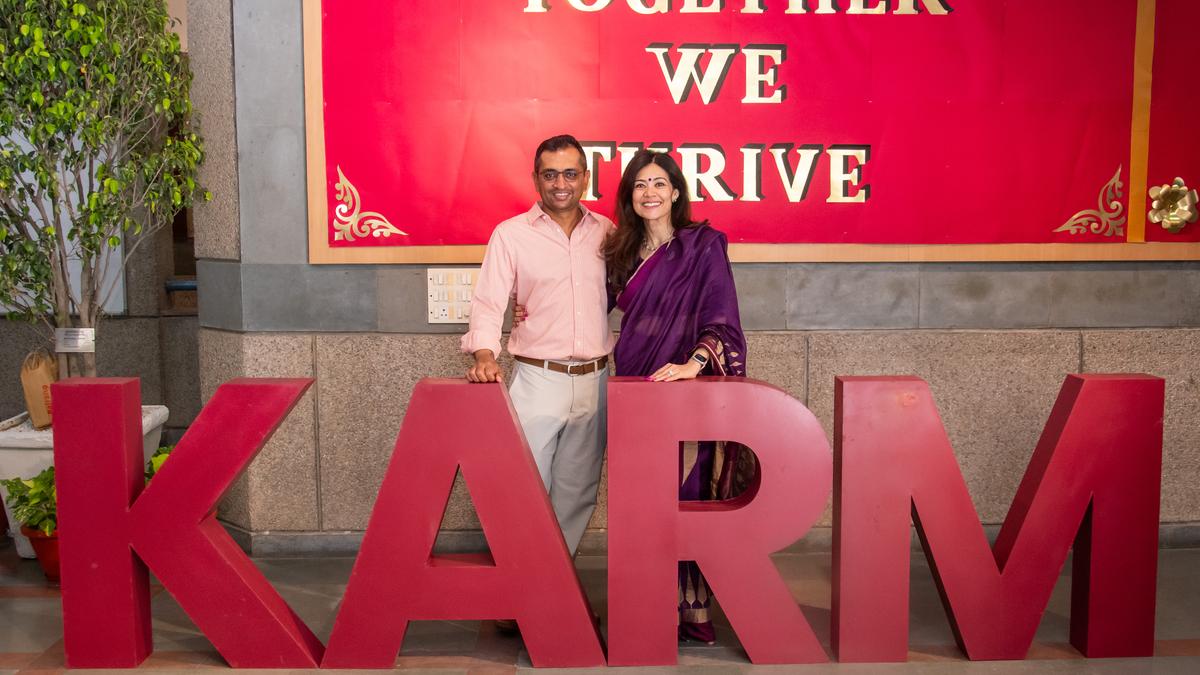
Ansuiya, who hails from a family of migrant workers from Bundelkhand, was born at a construction site in Sonipat, Haryana, and spent the first five years of her life there. “No one in my family had gone to school, and I was expected to get married young. But when I moved to my grandparents’ village, they enrolled me in a government primary school,” she said.
Ms. Ansuiya, the first among her seven siblings to pursue education, saw her life change in Class 5 when she cleared the entrance examination for VidyaGyan, a fully funded residential school for academically gifted students from rural backgrounds. She spent the next seven years there and went on to become a national topper in the Central Board of Secondary Education Class 12 examinations.
After securing admission to Delhi University’s Lady Shri Ram College, Ms. Ansuiya was selected for the KARM Graduate Fellowship, which covers everything from tuition fees to travel expenses.
“Without that support, pursuing higher education would not have been possible for me,” she said. “Karm also exposed me to internships, workshops and organisations. The transition from a village to a city can be overwhelming, but Karm helped bridge that gap.”
Now, Ms. Ansuiya works at Genpact as the chief of staff to the business sales practice team, becoming the first person in her family to enter the organised workforce.
Financial independence
Founded in 2018 by Radhika Bharat Ram, the organisation grew out of a troubling reality: only 1% of domestic philanthropic and corporate social responsibility funding in India goes towards gender equality and women’s rights, according to the Philanthropy Report series published by Dasra in collaboration with Bain & Company.
Ms. Radhika, who belongs to the family that founded Shri Ram College of Commerce, traces the trust’s beginnings to a more personal conviction — that financial independence is fundamental to women’s agency.
In the years since, Karm Trust has expanded beyond education through initiatives such as Karm Awaaz, a socio-emotional intervention; Karm Conclave, an annual gathering for young women; and Karm Vidvata, a learning resource hub. Yet fellowships remain central to its work.
STEM fellowship
“Next year, in either September or October, we plan to launch a STEM (science, technology, engineering and mathematics) fellowship,” said Ms. Radhika, who is also the joint vice-chairperson of The Shri Ram Schools, Delhi-NCR, and a board member of the SRF Foundation.
For now, the trust runs two fellowship programmes — the KARM Graduate Fellowship and the KARM Law Fellowship.
The programmes are open to young women from households with a combined annual income of less than ₹5 lakh. While the all-expenses-paid graduate fellowship opens the doors to nearly 45 colleges affiliated with DU, the law fellowship supports students seeking admission to any of the three centres of the Faculty of Law at the university.
‘Real risk’
“There are schemes such as Beti Bachao, Beti Padhao that are instrumental in ensuring a girl’s elementary education,” said Ms. Radhika. “But the real risk comes later, when they grow up. Many are forced to choose marriage over pursuing higher education. That’s where we step in,” she added.
Beyond financial assistance, fellows receive mentorship, English-language support, digital skills training, laptops and access to workshops designed to help them navigate higher education and professional life.
For many fellows, that mentorship becomes as significant as the scholarship itself.
Pathway to ambition
One such mentor is Tara Singh Vachani, vice-chairperson of Max India Ltd., who was drawn to Karm by the clarity of its mission. “What appealed to me was not just the ambition of the programme, but how thoughtfully the pathway towards that ambition had been designed,” she said, adding, “There was a very clear articulation of the ‘how’, and therefore of the outcomes.”
At a personal level, mentorship also became a learning experience. “I wanted to understand my own strengths and limitations while supporting someone whose life experiences were completely different from mine,” Ms. Vachani said.
Each mentor is typically paired with one fellow and expected to spend at least an hour every month with them. Karm supports the process through mentorship guides and monthly resource sheets, but the emphasis remains on conversation rather than instruction.
“The intention is not to direct or prescribe,” said Ms. Vachani. “It is to listen, ask questions and share one’s own lived experiences. The idea is to equip young women to think for themselves and engage with different world views.”
Unlike many mentorship programmes, Karm places clear boundaries around the role. Mentors are not expected to provide financial support, jobs or material resources.
Shoulder for mentee
Ms. Vachani added, “The only real responsibility is to give your time. To be a shoulder for your mentee, with grace, honesty and respect.”
The relationships often outlast the fellowship itself. Ms. Vachani still keeps in touch with former mentees, including Reetu, who now works in the social sector, and another fellow who went on to enrol in the law fellowship after completing the graduate programme.
For Ms. Ansuiya, the impact of that support is difficult to separate from her own journey.
After graduating from Lady Shri Ram College, she went on to pursue higher studies at Ashoka University before joining Genpact. Looking back, she sees Karm not merely as a scholarship provider, but as a bridge between two worlds.
“From a village to a city, there is a huge gap,” she said. “Karm helped bridge that gap.”
Ms. Ansuiya represents the kind of trajectory the trust hopes to make possible — one that begins in disadvantage and leads to opportunities that earlier generations of women in her family never had.
#village #boardroom #Karm #Trust #empowering #women