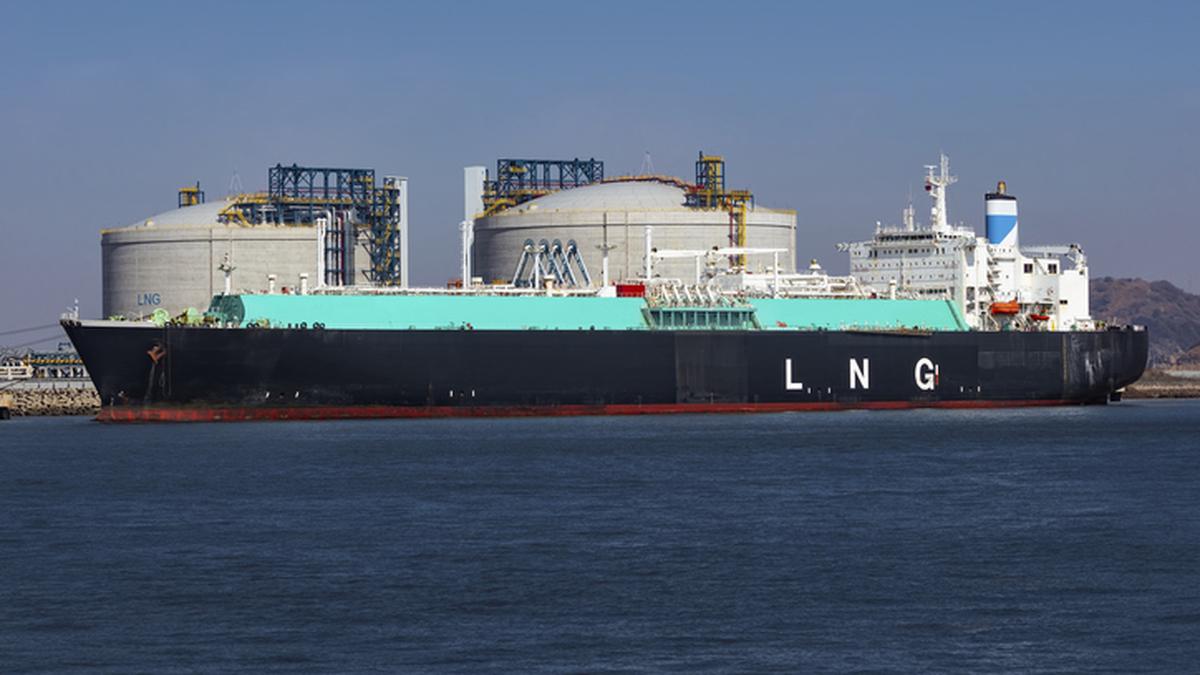

Representative image
| Photo Credit: Getty Images/iStockphoto
U.S. Vice President told CNBC that though Iran’s nuclear programme would need substantial negotiating, there was an understanding between the two countries that the strait would reopen “in a toll-free way for the long term, and that’s the sort of thing that we’re going to figure out in these technical negotiations.” Earlier, President Donald Trump had said that the area was being de-mined and that traffic would return to pre-war levels over the next couple of weeks.
While details of the agreement, likely to be known on June 19, will help global shipping companies decide on transits, one of the focus areas has been Liquified Natural Gas (LNG) shipping.
Today (June 16, 2026), Qatari officials reportedly told investors that within weeks production can increase to 83% of original capacity — 17% was damaged in war attacks. Shipping observers are reporting that those that may try to exit first in numbers may well be LNG ships, which is good news for India. LNG imports are critical for domestic fertilizer manufacture required for the ongoing kharif season.
On Monday (June 15, 20216), Indian government officials sought to address concerns saying 16 fertilizer-laden vessels are awaiting passage through the Strait, including eight urea carriers, four DAP ships, three sulphur carriers and one ammonia vessel.
Through May, LNG ship transit started happening on the sly with many ships switching off the Automatic Identification System and taking the Oman route, indicating they were not explicitly permitted by Iran. LNG carrier Umm Al Ashtan, which had departed Dahej in Gujarat after unloading its cargo there, headed to Strait of Hormuz beginning of May.
India’s Disha crossed on Monday, June 15. Junlin Wang, analyst, gas and LNG research, Rystad Energy says that as of 16 June, around 13 LNG vessels had crossed the Strait of Hormuz.
“Since last week, the main new confirmed movements were Al Daayen, Lebrethah, Rasheeda and Marigold. Al Daayen, Lebrethah and Rasheeda were Qatar-related / Ras Laffan-loaded cargoes, while Marigold was UAE / ADNOC-related, loaded from Das Island. Their destinations are mainly Asia, including China, Pakistan, Southeast Asia and India,” she said and added, “We expect the recovery to be gradual rather than a full restart of normal Hormuz traffic upon the final confirmation of the deal.”
Qatar and UAE LNG exports are a key part of global LNG supply, together reaching around 86.5 Mt in 2025, equivalent to about 7.2 Mt per month. This represents roughly 19.5% of global LNG exports. “The destination exposure is heavily Asia-oriented. In 2025, around 23% of Qatar/UAE LNG flowed to China, 16.6% to India, 9.3% to Taiwan, 8.2% to South Korea, 8.2% to Pakistan and 4.9% to Japan” said Ms. Wang.
Published – June 16, 2026 09:17 pm IST
#LNG #ships #headline #Strait #Hormuz #transits