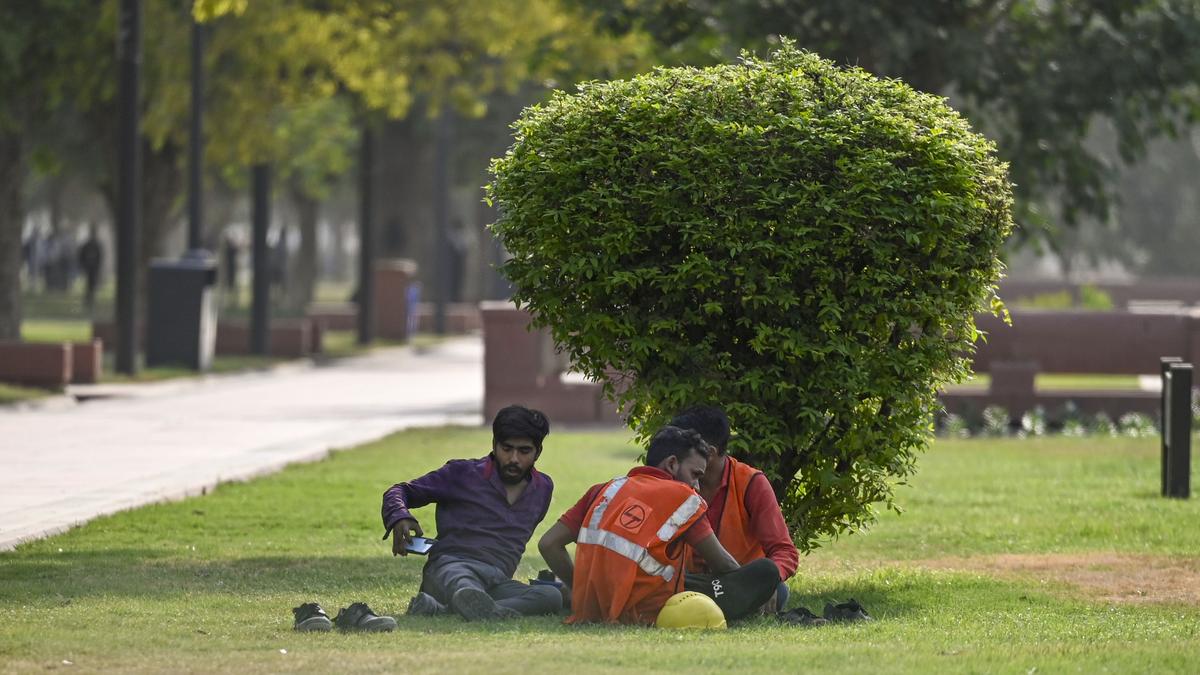
Trees can cool neighbourhoods by between 2°C and 12°C. And though Noida, just under 50 km from New Delhi, may boast 726 parks and 800 kilometres of green belt, its cooling infrastructure is unevenly distributed. The city’s pockets of shade and greenery are often concentrated in affluent enclaves, far from the dark stores, construction sites and arterial roads where gig workers spend much of their day.
Take Shajid, a gig worker who makes delivery runs in Greater Noida’s Patwari. His service platform’s 10-minute guarantees see him racing against the clock, shuttling between Blinkit dark stores and delivery destinations on his two-wheeler, pushing through traffic, speeding or breaking red lights, all under the harsh Noida sun — where temperatures can reach a staggering 46°C. For workers like him, relief is fleeting: a few minutes in the air-conditioned lobbies of upscale residential towers while waiting for an elevator.


“Gig and domestic workers, and people who have to be in the public arena have no place to rest. In the afternoon, some parks in the city are locked.”Avani ChokshiLabour lawyer

Gig workers of Swiggy taking a break
| Photo Credit:
Getty Images
Cities without shelter
The Patwari locality of Greater Noida is a fast developing area with large apartment complexes, some with 30-plus towers that house thousands. People pay crores of rupees to secure their place in these gated communities and apartment complexes with manicured gardens, meticulously maintained parks, walkways and clubhouses. As welcoming as these private-public spaces are for the residents, they are cordoned off to others. So, what about the workers who toil for hours in these sprawling houses? Where is their access to leisure and rest?

A premium apartment complex with parks, walkways and clubhouses — welcoming to residents, cordoned off to others
| Photo Credit:
Pooja Salvi
Unfortunately, this story is playing out across the country. Avani Chokshi, a labour lawyer from Bengaluru, says urban planning has been hostile to common people. “Gig and domestic workers, and people who have to be in the public arena have no place to rest,” she states. “In the afternoon, some local parks in the city [Koramangala’s Lakshmidevi Park, Citizen Park in R.T. Nagar, and many others] are locked; they open only during the early morning hours and evenings.” If you ask a guard, they’ll tell you it is to keep “nuisance and illegal activities” at bay.

Avani Chokshi, a labour lawyer from Bengaluru
| Photo Credit:
Special arrangement
In reality, such closures hinder The Karnataka Parks, Play-fields and Open Spaces (Preservation and Regulation) Act, 1985. The State legislation is designed to protect, manage and regulate green spaces, recreational areas, and open lands within urban areas. Recently, when a citizen tried to raise this issue on Bengaluru’s civic grievance app, Sahaaya 2.0, it was updated stating, “Park will be open morning at 5AM to 11AM and evening 4PM to 8PM. Resolved complaint.” The irony was clearly lost on them.
The World Health Organisation prescribes 9 sq.m. of green space per capita in urban areas, but cities like Chennai and Pune have just 0.81 sq.m. and 1.4 sq.m. per capita respectively. Bengaluru offers approximately 2.25 sq. m., Delhi 2.9 sq.m., and Mumbai 1.24 sq.m.

Commuters brave the heat in Delhi-NCR
| Photo Credit:
Getty Images
“One has the right to be in a public space,” adds Chokshi. “Anyone who doesn’t have a good house or place to rest should be able to find open, accessible spaces outside without spending money.” Nationally, Articles 19 and 21 of the Indian Constitution protect freedoms and life (Article 19 promises six democratic freedoms: of speech, assembly, association, movement, residence and profession, while Article 21 guarantees the right to life, dignity and personal liberty). But most people are unaware of them.
What is public space?
“Public space includes ‘functional’ sites such as streets, public toilets, bus stops, railway stations, marketplaces and modes of public transport, such as buses and trains, as well as recreational areas, such as parks, maidans, waterfronts and promenades,” state authors Sameera Khan, Shilpa Phadke and Shilpa Ranade in their book Why Loiter? Footpaths, pavements, and/or sidewalks are also considered an important part of public urban infrastructure meant for unobstructed pedestrian movement.
The cost of staying cool
Prema Kumari works as a cook for several families in North Bengaluru’s gated communities. The 53-year-old makes three meals a day in four kitchens. Her job begins at 6.30 a.m. and ends by 7 p.m. “I am not allowed to even sit on the benches in the society’s gardens,” she tells me, about the moments of rest she gets in between. “The security guards shoo us [domestic workers] away. If we want to sit down, we must go sit outside the society.” With no benches under the trees outside, Kumari goes down to the stuffy basement, where she has made friends with the laundry woman.

Prema Kumari works as a cook for several families in North Bengaluru, but during the day she isn’t “allowed to even sit on the benches in the society’s gardens” to rest
| Photo Credit:
Pooja Salvi
“I am not allowed to even sit on the benches in the society’s gardens. The security guards shoo us [domestic workers] away. If we want to sit down, we must go sit outside the society.”Prema KumariCook
In their seminal book, Why Loiter? Women & Risk on Mumbai Streets (2011), journalist Sameera Khan, sociologist Shilpa Phadke and architect Shilpa Ranade ask why citizens should not find pleasure in their city spaces. And, more importantly, who has access to these spaces? “If women, marginalised groups, so-called ‘outsiders’ or the working class population have no access to a space, then it hints at what kind of a person is an acceptable citizen in society,” Khan says over a phone call.

Sameera Khan, Shilpa Phadke and Shilpa Ranade
| Photo Credit:
Avadhoot Khanolkar
The book finds that urban planning is patriarchal in nature, and designed almost always with an able-bodied, middle or upper-class, upper caste, cis-het man in mind. Anyone who doesn’t fit this description just has to make do with the infrastructure they get. “We want the labour of working class people, but not their presence in the spaces that surround us,” she adds.

A woman trying to stay cool a scorching day in Noida
| Photo Credit:
Getty Images
Mercury rising
Last year, a study by the non-profit HeatWave found at least 84 heatstroke deaths recorded across India between March 1 and June 24. It noted that the true toll was likely to be higher due to diagnostic “blind spots”. The report titled ‘Struck by Heat: A News Analysis of Heatstroke Deaths in India in 2025’ found that Maharashtra reports the highest number of deaths at 17, followed by 15 each in Uttar Pradesh and Telangana.

Loss of democratic experiences
India’s metro cities are constantly in a state of work-in-progress: consumed by the never-ending construction of skyscrapers, Metro lines, roads, and newer extensions. For instance, in Chennai, Metro Rail work has been ongoing for over 17 years, in various parts of the city. Things are not too different in Mumbai and Bengaluru; in the latter, the work’s moving at a snail’s pace, averaging just 7 km per year.

Chennai Metro’s tunnelling from Purasawalkam to Kellys
| Photo Credit:
B. Jothi Ramalingam

Metro rail work in progress on OMR
| Photo Credit:
Velankanni Raj B
Parks, maidans, beaches, footpaths, public libraries and even neighbourhood markets — once a testament to India’s democratic nature — are quickly disappearing. Their patrons are policed, surveilled or pushed towards private-public spaces such as malls that welcome them only as consumers. As gated communities and private experiences multiply, truly public spaces are at risk. The erosion of such spaces directly results in the loss of non-curated, mixed-class, unfiltered encounters.
“A free public park does not ask who you are before letting you in. It naturally allows for a mix of classes, languages and backgrounds,” says Shruti Sah, who started the initiative Cubbon Reads in 2022 with her partner Harsh Snehanshu. “For many, especially those without access to private leisure spaces, parks become essential grounds for pause, movement and presence.”

Cubbon Park is among the few parks in Bengaluru that stays open during midday. Many are locked in the afternoons
| Photo Credit:
Courtesy Cubbon Reads
As part of Cubbon Reads, Bengaluru’s readers gather every Saturday to read silently. “We have seen migrants who are new to the city, families, students and regulars all occupy the same space without friction,” Snehanshu says, adding, “Access to something as simple as sitting on grass now increasingly requires entry into a park. As spaces marketed as ‘living in nature’ often come at a premium and are tied to privilege.”
Lessons from Kochi and Jaipur
As temperatures rise, cities such as Jaipur, Ahmedabad, Pune and Hyderabad are taking small steps. In the Pink City, a solar-powered cooling station offers 5°-6° C relief to pedestrians and workers. In Chennai, airconditioned rest lounges (in pic) have been opened for gig workers.

Gig worker’s lounge in Chennai
| Photo Credit:
Velankanni Raj B.
In Kochi, ‘Kawaki’, a community-led urban greening movement launched in 2021, has created several recreational green spaces by planting native tree saplings. “Kawaki flipped the script on conservation by making neighbourhood stakeholders the primary custodians,” says Priya Narayanan, senior programme manager–urban development, WRI (World Resources Institute) India, who was involved in its planning. “This started with Mapathons [mapping events to identify suitable spaces for urban micro-forests].”

Unlike many urban greening programmes, Kawaki is data-based, scientifically reviewed, and sustainably implemented.
Demand and defend public spaces
According to UN-Habitat, the programme for sustainable urban development, 30% of city land should be reserved as public open space. Indian cities barely cross 10%. The World Health Organization prescribes a minimum of 9 sq.m. of green space per capita in urban areas, but cities like Chennai and Pune have just 0.81 sq.m. and 1.4 sq.m., respectively. Bengaluru offers approximately 2.25 sq.m., Delhi 2.9 sq.m., and Mumbai 1.24 sq.m.
Best green cover globally
1. Oslo, Norway boasts 67% tree coverage, featuring vast protected forests known as Oslomarka, urban parks and sustainability initiatives.
2. Ljubljana, Slovenia reportedly has over 540 sq.m. of public green space per resident — all open and accessible to the public.
3. Frankfurt, Germany has 52% green spaces, including inner city gardens such as Frankfurt City Forest, community gardens and protected nature reserves like Schwanheimer Duenen and Enkheimer Ried.
4. In Singapore, the ‘City in Nature Green Plan’ is being implemented to conserve and integrate nature. It boasts about 50% green space that features vertical gardens, micro-habitats, and nature reserves.
5. Vienna, Austria boasts about 200 sq. km. of green spaces or water bodies, which is approximately 50% of its land area.

Aerial view of Frankfurt City Forest
| Photo Credit:
Getty Images/iStock
One of the main concerns Khan and the others have is: citizens are not aware of eroding spaces. As they, unquestioningly, learn to live without parks, lakes, benches and tree-lined footpaths, they are running the risk of losing more such spaces. “If citizens don’t actively choose to use public spaces because they don’t find them in their vicinities or find them unclean or inaccessible, they won’t notice when these spaces disappear or increasingly get privatised [given to builders or private developers],” Khan says. The more people are pushed towards enclosed, privatised spaces, the more the idea of freely occupying a city begins to wear away.
Right to Public Space Bill
According to the bill that was introduced in the Rajya Sabha on December 8, 2023, citizens must have free, accessible areas such as parks, streets and libraries, where they can gather, protest, and engage in social or cultural life. V. Sivadasan from the Communist Party of India (Marxist) and a Rajya Sabha member from Kerala, who introduced the bill in the House, noted, “Free access to a deliberative public space is a fundamental human right. Access to empowering, educative and transformative public spaces is the right and necessity for every human being. There is a need for the establishment of public spaces where people can meet, discuss, debate, deliberate and learn. There is an urgent requirement to establish, attain and ensure the right of free access to public space to every citizen of the country.”
The only way that public spaces can survive is if people demand, use and defend them. Not just in moments of protests — for tree felling or demolished parks — but in everyday life, by recognising that lakes, parks, footpaths and playgrounds are as essential to city infrastructure as highways, flyovers and tunnels. The power is in our hands: whether we want to build cities for consumption and exclusion, or cities that can make room for pause and co-existence.
The writer is a features journalist exploring culture, people, and urban life.
#place #rest #sweltering #Indian #cities #relief #unevenly #distributed