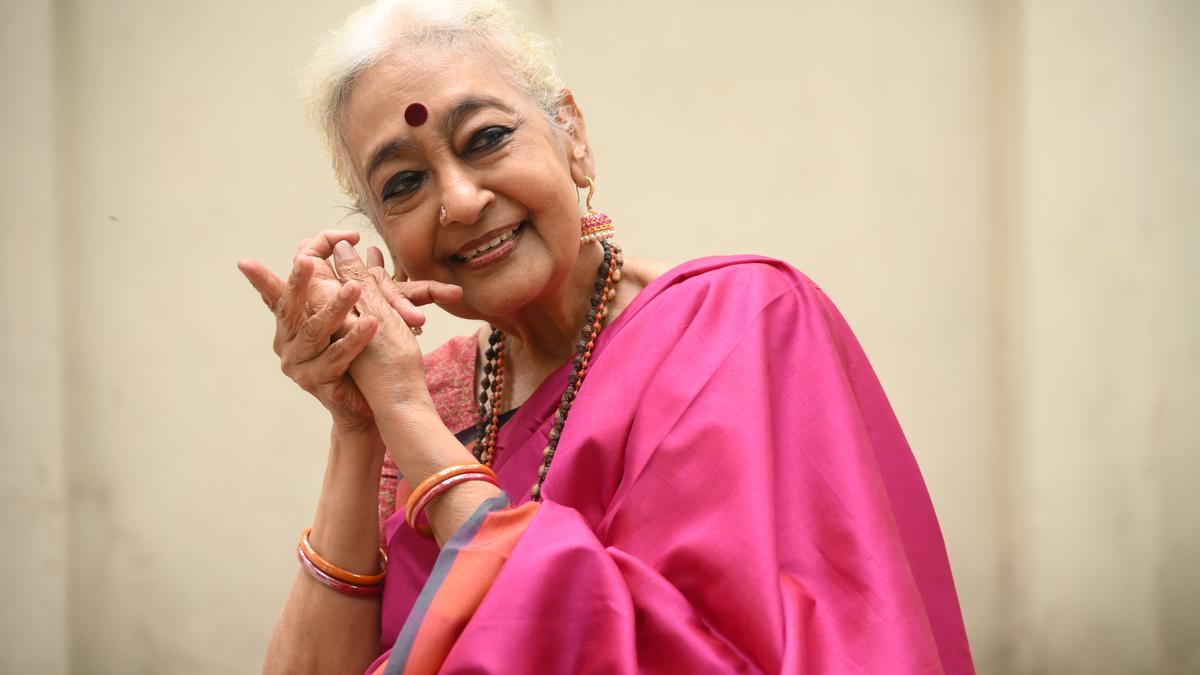
It’s a warm, humid morning. As Sudharani Raghupathy, draped elegantly in a pink sari, walks into the sunlit space between her home and dance school, Bharatalaya, in Chennai’s Mylapore, you notice a slight limp in her step. “It’s not age, I just hurt my toe,” she laughs, settling down to talk about dance. But instead of retreating into nostalgia, she seems curious about what lies ahead. Listening to the Bharatanatyam legend — poised, articulate and full of vitality — you cannot help wondering whether age matters at all.
As her conversation moves seamlessly from the present to the past, Sudharani proves you wrong should you think technology is the preserve of Gen Z. At 82, she speaks of it with ease and has strong views too. “I agree AI can do anything. You feed it millions of permutations and combinations. But there is something beyond it, which only the human brain can do,” she says. “When we improvise abhinaya in a padam, can the AI reproduce it? Because we are responding on the spot, on stage, at that very moment. That’s art.”
Sudharani punctuates the thought with a brief, eloquent abhinaya — a fleeting smile, an arched brow, a roll of her kohl-rimmed eyes, a tilt of the head and hands that transform into precise mudras. She evokes a lifetime spent perfecting stance, movement and expression under revered vadyars.
Chosen recently for the Sangeet Natak Akademi Fellowship (Akademi Ratna), she embodies the essence of dance: a space where tradition, spontaneity and emotion converge beyond the reach of machines.
“The award is a reaffirmation of my faith in the lineage of the Thanjavur Quartet, who gave the dance form its repertoire and structure. I am fortunate to have belonged to that parampara. I am only a link, like many others. But it’s not just my achievement, it takes a whole band of people to create something enduring,” she says, her words carrying both humility and pride.
This collaborative spirit was something she imbibed at home and through her approach to art. She juggled the roles of wife, mother and daughter-in-law with that of an artiste, while holding firmly to the belief that being a dancer alone was not enough to be creative.

Sudharani thinks a dancer should imbibe other art and craft forms
| Photo Credit:
K. V. SRINIVASAN
“After my husband and children left for office and school, and once I was done with the household chores, I would shut myself in a room every day for a dedicated practice session. There were days when I did not get enough time to rehearse before a performance, but my daily sadhakam always came in handy.
“My world revolved almost entirely around home and art. I never really got to make friends or socialise, but my artistic pursuits gave me a sense of fellowship and inspiration.”
One such enriching association was with craft revivalist Kamaladevi Chattopadhyay. “Through my interactions with artisans, I learnt pottery, embroidery, fabric printing and weaving. I built up a large collection of handcrafted saris with unique motifs designed by me. Recently, during a visit to a village, I realised I had not forgotten those skills. I sat down and made a few small pots,” she recalls.
According to Sudharani, a complete dancer must appreciate other art and craft forms as well. “They deepen your creative sensibilities and help you engage with the art in a far more personal and meaningful way.”

Sudharani trained under revered gurus
| Photo Credit:
The Hindu Archives
These pursuits beyond dance also shaped her social outlook. Discrimination and social divides rarely figured in conversations at home or in her school. “Caste makes no sense to me. Whatever your background, your art should be your identity. More than anything else, what matters is acceptance by the audience. Once that bond is established, everything else fades into oblivion.”
Though rooted in a traditional learning environment under gurus and scholars such as K.P. Kittappa Pillai, U.S. Krishna Rao and Mylapore Gowri Ammal, and trained in Carnatic music by violin maestro T. Chowdiah and vidwan Madurai N. Krishnan, Sudharani’s artistic vision was never constrained by convention.
“Two things I learnt early on were never to suppress the ‘I’. It must be there; if it collapses, you might lose the curiosity to expand your horizons. The second was never to say ‘no’ to an opportunity, even if it meant stepping out of your comfort zone.”
She embodied this philosophy, when, in 1964, she became one of the first Indians at Randolph-Macon Woman’s College in Virginia. There, she studied the history of world dance and studio arts, trained in the Martha Graham technique and learnt Western music from Elaine St. Vincent.

Sudharani has also trained in the Martha Graham technique
| Photo Credit:
B. Thamodharan
“The Martha Graham technique is a departure from traditional ballet, with its emphasis on breath, contraction and release rather than ballet’s verticality and reliance on pointe work. I realised that we already had some of these principles in our own system. So my body responded to it naturally. Once back home, I never tried to fuse the technique into my performances because our country offers such a vast range of styles, even within a single genre.”
That said, she is welcoming of those who choose to experiment with the form.
“Why not?” she asks. “After all, art is about communication. The real question is: what are you communicating? If you want popularity or awards, that is fine. But what are you giving your audience? There will always be criticism, but that should not stop you from trying. If people can connect with it, go ahead.”
An instinct that is both refreshing and heartening. “Growing old does not mean closing yourself to newness. If Brahma were to ask me what I wanted — youth, beauty, fame or money — I would say, ‘Give me the vision: the ability to look ahead. The past has been wonderful, but I am curious to see where our culture takes us as technology and tradition negotiate new ways of coexisting,” she says with a warm smile.
Published – June 25, 2026 06:50 pm IST
#art #outshine #Sudharani #Raghupathy #thinks