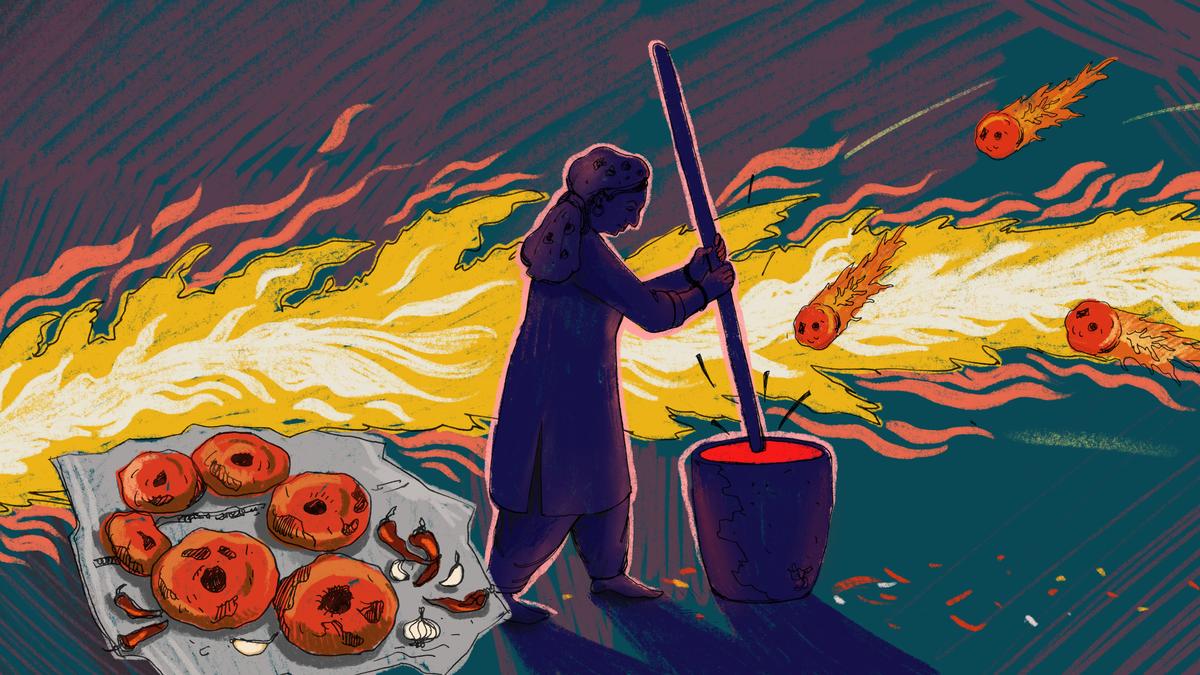
Many years ago, on a mild May afternoon, I walked towards Phuphee’s kitchen expecting her usual warm welcome. But on that particular day, I saw her outside standing over a kanz (a large mortar made of rock) with a muhul (a long pestle made from wood) in her hand, pounding away as if her life depended on it.
I waited in silence for her to look up, but she didn’t. So, I walked into the kitchen where Aisha, Phuphee’s household help, raised her eyes from the daan and greeted me. She took my bags and asked me to sit down. She poured a hot cup of kehwe from a large samovar and served it with some sheermaal (a savoury biscuit). I sat there eating and drinking, quietly wondering what Phuphee was up to. Aisha must have noticed me glancing out the window, so she said, ‘Aem nyu dilas pyeth [she has taken it to heart].’
I asked her what Phuphee had taken to heart. Aisha got up from the daan, poured herself a cup of kehwe and sat next to me. She narrated the awful story of Sameena.
Sameena was a woman who lived in the village. She had been diagnosed with a life-limiting illness. Unfortunately, she didn’t have very long left, maybe a few more months if she was lucky. She had three children, the youngest not yet 10 and the eldest still in secondary school. She lived with her husband, his parents and her children.

Aisha explained that Sameena now kept mostly to her bed. The illness and the treatments had completely drained her of energy. She spent most of her time sleeping. Phuphee would go and see her from time to time, and take her nourishing little treats to tempt her appetite. But Sameena would take a few small bites and leave the rest.
A few days ago, Phuphee had gone to see her and had come back furious. Apparently, Sameena’s mother-in-law had asked Phuphee if she had any ‘prospective brides’ in mind for her son, to which Phuphee had replied, ‘He already has a wife’. The mother-in-law had explained that she was an old woman now (referring to herself) and couldn’t be expected to raise three young children and look after everything else, including a dying woman. ‘Besides,’ she had added, ‘my son needs a woman to take care of him.’
Phuphee had tried to keep calm, but with every single syllable that came out of the woman’s mouth, her patience waned. She had got up and before walking out, said to the old woman, ‘A fire warms your home. Show it the respect it deserves. You should wait till the fire dies out on its own. Let the embers cool and turn to ashes before you light a new fire. If you light too many fires at once, you will burn your house down.’
When she had come home, she had wept. When she could weep no more, Phuphee had instructed every single household help to gather ingredients for vaer. (The spiced cake is made from pounding together red chillies, garlic, shallots and whole spices. Mustard oil is added to the thick paste and left to ferment before being moulded into cakes and left to dry for a couple of days. It is used throughout the year to season dishes from simple fried eggs to meat or vegetables.)
‘You know she only makes vaer when she feels like she is at the end of the road, when she feels helpless,’ Aisha said, sighing.
For the couple of days I was there, I watched Phuphee from a distance. I had never seen her so lost and distant. She kept pounding the muhul into the kanz with determination, as if the answer to all her questions lay at the bottom of the kanz. I left for Srinagar the same way that I had come — without saying anything to her.
I visited Phuphee again in late October that year. She was back to her usual self except she seemed to have gained an unusual amount of gray around her temples and a few lines around the corners of her eyes. I asked Aisha later what had become of Sameena and if her husband had married again.

Sameena had passed away in July, she told me, but her mother-in-law hadn’t gone ahead with trying to find a new bride for her son. Upon hearing this, my ears twitched and I blurted out, ‘Did Phuphee cast a spell on the old woman?’
Aisha smiled and said she didn’t know anything about a spell, but Phuphee did send the old woman every single vaer she had made. ‘You know what that means, don’t you?’ Aisha asked.
‘What?’ I replied.
Aisha lowered her lips to my ears and whispered, ‘When she sends a vaer, it is a warning.’
‘I cannot say anymore,’ she continued. ‘I really don’t want to spend the rest of my days as a goat or a worm.’ And with that she went back to her chores.
I asked Phuphee later if it was true. Had she really sent the vaer as a warning? She looked at me amused.
‘I don’t know what you are talking about. I wish I was half as powerful as you believe me to be myoan zuv [my life], but unfortunately I am not,’ she said, sighing and then continuing to smoke her two cigarettes, drawing the breath deep into her lungs.
When she had finished, she got up, but before disappearing into the corridor she turned around and said, ‘But maybe being misunderstood in some situations isn’t such a terrible thing!’
Saba Mahjoor, a Kashmiri living in England, spends her scant free time contemplating life’s vagaries.
Published – June 25, 2026 03:41 pm IST
#Column #Saba #Mahjoor #Phuphee #chilli #cakes