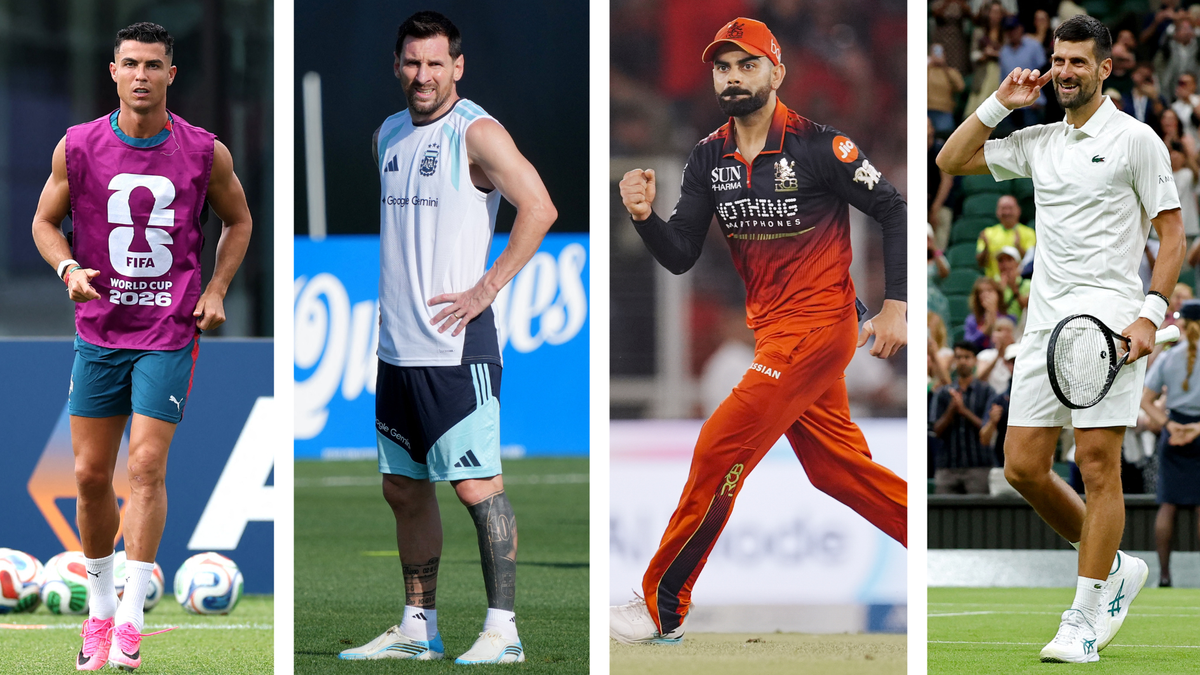
Four great contemporary champions are in action simultaneously. The oldest, Cristiano Ronaldo, is 41, and playing his final World Cup, as is Lionel Messi, 39. In England, Novak Djokovic, 39, is attempting a record 25th Grand Slam title. Playing nearby will be Virat Kohli, 38, cricket’s version of the others.
For nearly two decades, these men owned sporting time. But all sport conspires against longevity. Before Messi won a World Cup four years ago, many had already written his epilogue; but he is showing his hunger again. Ronaldo continues scoring with the determination of a man negotiating with biology. Djokovic keeps returning from injuries and controversies. Kohli remains Kohli, only more so. All very inspiring, possibly absurd too. Great athletes normalise absurdity, delaying our tryst with middle age.

Djokovic began as the inconvenient third man in a love story featuring Roger Federer and Rafael Nadal. By the time history paused to count, he had accumulated numbers that demanded conversations about the greatest of all time, the fan’s favourite acronym, GOAT. He became statistically the greatest while never quite becoming the sport’s most universally beloved. Sport, like literature, prefers flawed heroes to perfect accountants.
FIFA World Cup 2026: News, Fixtures, Results & Live Scores
In search of a unique hero
Significantly, as these athletes prepare to leave, their sports are in transition. Football belongs increasingly to systems, data models and pressing structures. The geometry of straight lines is taking over from the poetry of curves. The artist still exists, but is measured by sprint distances and defensive recoveries. Tennis has become a contest of physical power played at high speed by competitors who have inherited the standards Djokovic himself set. Ironically, the champions shaped the landscape that will eventually exclude them.

Novak Djokovic on the first day of the 2026 Wimbledon Championships
| Photo Credit:
AFP
This was not always so. Roger Federer was fit, but not ridiculously so. Diego Maradona, whose feet painted some of the most colourful canvases in the game, was a less self-destructive Messi. The present could be explained in terms of the past.
Now, sport seems destined to go through a phase dictated by Artificial Intelligence before the unique hero emerges, unexplainable in terms of either AI or past champions. Carlos Alcaraz and Jannik Sinner and Vaibhav Suryavanshi and Ousmane Dembélé seem to be preparation for this. They are not the past. It is easy to see them as visitors from the future, but that is fraught too. Individual brilliance will emerge not as part of a continuum, but in opposition to it.

Spain’s Carlos Alcaraz
| Photo Credit:
AFP
Sport is changing not just technically and in the manner fans (‘customers’) consume it, but in a more fundamental way.
Reducing toxic nationalism
I belong to the generation which believed that there is no greater glory for an athlete than representing their country at the highest level. It was an article of faith. But the sands have shifted beneath my feet. I am no longer so sure.
It might have something to do with the 48 teams in the World Cup, many of whom would struggle against a European club side. Or India losing a T20 series in Ireland, a country low down the pecking order. The idea of the ‘highest level’ is changing. It is not always the national side.
This might not be such a bad thing. It will reduce the toxic nationalism of the World Cups and the Olympics. It is interesting to watch Messi play for Argentina, but watching Messi, Brazilian Neymar Júnior and Frenchman Kylian Mbappé play together for Paris Saint-Germain can be more thrilling. There is an element of purity here: sport as it ought to be played, with the best in action regardless of country affiliations.

Kylian Mbappé of France controls the ball during the FIFA World Cup 2026
| Photo Credit:
Getty Images
Club vs. country is an old argument, as is the gradual evolution from one to the other. There is a strong case for the World Cup when you realise that about 70% of the players might not get worldwide attention otherwise. The impact of such exposure is huge for the sport in their countries. Clubs controlling a sport will lead to monopolies, and take it beyond the average fan. It is a good moral argument. Sport, however, does not evolve morally. Money, convenience, politics, media influence its direction.
Goodbyes in sport are reminders of our own mortality. What unites Messi, Djokovic, Kohli and Ronaldo is both prolonged excellence and durability, a rare combination. In their final days at the top, we realise what impossible standards they set, standards we have taken for granted.
The writer’s latest book is ‘Why Don’t You Write Something I Might Read?’
Published – July 04, 2026 10:26 am IST
#Sport #GOATs #Whats #Messi #Ronaldo #Djokovic #Kohli